A friend of mine attends Notre Dame and recently sent a few of us this link to a story in the NY Times about some of the recent academic freedom/freedom of expression issues in which the campus is embroiled. One of the sparks to this controversy is t-shirts (shown in a photo in the story) which read, “Gay? Fine By Me.” I must say, given the sense of humor in our circle of friends, we have a lot of fun playing with that t-shirt idea. We have discussed the relative merits of t-shirts that read, “Necrophile? Fine by me?” or the oddly insignificant, “Steve? Fine By Me.” Anyway, you get the idea.
The article does a good job of presenting the lay of the land and some of the special issues involved with being a major University and religiously committed on a significant level at the same time. Does academic freedom/freedom of speech mean anything ought to be honestly presented? Does a Catholic or religious commitment mean that there are other priorities higher up the food chain than “freedom” of academic expression? Can or should some expressions be squelched in the service of these higher priorities?
I was pondering Aristotle and virtue this morning. (That sentence makes me sound smarter than I really am.) But I believe Aristotle would be in favor of excluding some forms of expression from education. If it did not serve the flourishing of the human, it probably served to debase it. Therefore, the best thing for any individual’s education is to avoid such base and animalistic things. Plato actually argues that in his Republic. So if these Greeks are right, the question now is, does “The Vagina Monologues” serve to increase virtue and human flourishing, or is it base and profane?
A couple of interesting quotes from the piece. From a student:
Some students said that the understanding of academic freedom at a Catholic university should be different from that at a secular university. "We have our own measures of what's good and what's right," said Nicholas Matich, 22, the politics editor of The Irish Rover, a conservative student newspaper. " 'The Vagina Monologues' is performed everywhere else in the academic world. It doesn't mean Notre Dame should do it, too."
From a former faculty member and current watchdog at the University:
"I think the real test of a great university," he [Father Hesburgh] said, "is that you are fair to the opposition and that you get their point of view out there. You engage them. You want to get students' minds working. You don't want mindless Catholics. You want intelligent, successful Catholics."
Does a great University allow anything to be taken seriously, or does it allow only serious things to be taken seriously-including opposing points of view. Is a great University gauged by the number of voices heard on campus or in its ability to discern between voices?
Of course, many will object that gauging what is serious is wholly subjective, and therefore oppressive and given to censorship. I submit that that response may be given by those who need to read more of their Aristotle.
Friday, February 24, 2006


Wednesday, February 22, 2006
Moratorium on Theological Pronouncements?
I may have been out of the fray for a while, but I can still recognize a contentious issue when I see one. Brian McLaren has raised the pastoral issue of handling homosexuality in our churches in a rather provocative manner. As one might expect with McLaren, his intent is primarily pastoral, and for that I applaud him. Too often, because it is such a hot-button issue, Christians react callously instead of lovingly to homosexuality, and McLaren is right to provide a corrective voice in that manner.
The approach McLaren takes in the example in his essay is, I think, fundamentally right. Instead of reacting to the question, “what is your church’s stance on homosexuality?” with an immediate (and seemingly dogmatic) answer, it is wise to first ask questions and discover where the person is coming from.
But, as my regular readers might be able to anticipate, I am not comfortable with all of his positions. First, his fundamental conclusion:
Frankly, many of us don't know what we should think about homosexuality. We've heard all sides, but no position has yet won our confidence so that we can say "it seems good to the Holy Spirit and us." That alienates us from both the liberals and conservatives who seem to know exactly what we should think. Even if we are convinced that all homosexual behavior is always sinful, we still want to treat gay and lesbian people with more dignity, gentleness, and respect than our colleagues do. If we think that there may actually be a legitimate context for some homosexual relationships, we know that the biblical arguments are nuanced and multilayered, and the pastoral ramifications are staggeringly complex. We aren't sure if or where lines are to be drawn, nor do we know how to enforce with fairness whatever lines are drawn.
Perhaps we need a five-year moratorium on making pronouncements. In the meantime, we'll practice prayerful Christian dialogue, listening respectfully, disagreeing agreeably. When decisions need to be made, they'll be admittedly provisional. We'll keep our ears attuned to scholars in biblical studies, theology, ethics, psychology, genetics, sociology, and related fields. Then in five years, if we have clarity, we'll speak; if not, we'll set another five years for ongoing reflection. After all, many important issues in church history took centuries to figure out. Maybe this moratorium would help us resist the "winds of doctrine" blowing furiously from the left and right, so we can patiently wait for the wind of the Spirit to set our course.
Maybe five years is an arbitrary figure, but I don’t think any length of time is going to convince McLaren or his sort of emergent minister of any actual position. It is inherent in the postmodern psyche to never actually decide on any proposition. That is why he doesn’t do so now, and it is why he probably won’t have any more answers in 5 or 10 years. And if 2000 years of theology-ranging over every possible position, political régime, and social setting-can’t help them decide today, 5 more years ain’t gonna help.
McLaren is also worried that the political baggage surrounding homosexuality is too manipulative for him to cut through.
Most of the emerging leaders I know share my agony over this question. We fear that the whole issue has been manipulated far more than we realize by political parties seeking to shave percentage points off their opponent's constituency. We see whatever we say get sucked into a vortex of politicized culture-wars rhetoric—and we're pastors, evangelists, church-planters, and disciple-makers, not political culture warriors.
That, honestly, is no excuse for not being able to come to theological clarity about an issue. I have found that those who think politically first and theologically second are the same people who are too frustrated by political concerns to be of any real theological value. And in my reading of McLaren in the past, I tend to think he is political first and theological second.
The fact that an issue appears in political circles has absolutely no bearing on its theological standing. The theological value of a belief is not changed one way or another if one political party adopts it or another abhors it, or if there is a great deal of “confusion” about it in the circles of Manhattan elite. The truth value of the statement “God was in Christ reconciling the world to himself,” is not changed no matter how much political wrangling may occur over it. Or take the issue of pedophilia, which on one level is already a political issue. If it becomes a hot-potato, should we avoid calling it sin?
Because of their adherence to a postmodern view of the world, McLaren and others are unable to accurately apply the injunction to “speak the truth in love.” If you are fuzzy on the concept of “truth” or are incredulous toward it, you will want to jettison it in favor of other concepts. According to so much they say and write, “truth” is oppressive and unnecessarily harsh, and “love” is what we need instead of truth. As I have said before on this blog, the most loving thing we can do as Christians is speak the truth into people’s lives in a way that brings them closer to Christ. And besides, throwing objective truth overboard in favor of love is a crystal clear example of a false dichotomy-one that Christ even rejected.
At one point McLaren declares the biblical passages concerning homosexuality as complex and difficult to interpret (putting aside the fact that plenty of great NT scholars completely disagree). If they are difficult, they are difficult for the same reasons passages on fornication and adultery would be hard (How accepted were homosexual relationships in that culture? Would a married man and a boy be deemed adultery? Fornication? How much sexual “power” did women have, and would their sexual relationships be OK?). So then using the same criteria McLaren uses, when adultery becomes a political third rail and people want the church to be accepting of adultery, we should propose a gag-order on ministers declaring it a sin against God and family.
To be so easily manipulated politically and culturally is a bad position to be in-Scripture and God himself become the play grounds of polls and political breezes.
The approach McLaren takes in the example in his essay is, I think, fundamentally right. Instead of reacting to the question, “what is your church’s stance on homosexuality?” with an immediate (and seemingly dogmatic) answer, it is wise to first ask questions and discover where the person is coming from.
But, as my regular readers might be able to anticipate, I am not comfortable with all of his positions. First, his fundamental conclusion:
Frankly, many of us don't know what we should think about homosexuality. We've heard all sides, but no position has yet won our confidence so that we can say "it seems good to the Holy Spirit and us." That alienates us from both the liberals and conservatives who seem to know exactly what we should think. Even if we are convinced that all homosexual behavior is always sinful, we still want to treat gay and lesbian people with more dignity, gentleness, and respect than our colleagues do. If we think that there may actually be a legitimate context for some homosexual relationships, we know that the biblical arguments are nuanced and multilayered, and the pastoral ramifications are staggeringly complex. We aren't sure if or where lines are to be drawn, nor do we know how to enforce with fairness whatever lines are drawn.
Perhaps we need a five-year moratorium on making pronouncements. In the meantime, we'll practice prayerful Christian dialogue, listening respectfully, disagreeing agreeably. When decisions need to be made, they'll be admittedly provisional. We'll keep our ears attuned to scholars in biblical studies, theology, ethics, psychology, genetics, sociology, and related fields. Then in five years, if we have clarity, we'll speak; if not, we'll set another five years for ongoing reflection. After all, many important issues in church history took centuries to figure out. Maybe this moratorium would help us resist the "winds of doctrine" blowing furiously from the left and right, so we can patiently wait for the wind of the Spirit to set our course.
Maybe five years is an arbitrary figure, but I don’t think any length of time is going to convince McLaren or his sort of emergent minister of any actual position. It is inherent in the postmodern psyche to never actually decide on any proposition. That is why he doesn’t do so now, and it is why he probably won’t have any more answers in 5 or 10 years. And if 2000 years of theology-ranging over every possible position, political régime, and social setting-can’t help them decide today, 5 more years ain’t gonna help.
McLaren is also worried that the political baggage surrounding homosexuality is too manipulative for him to cut through.
Most of the emerging leaders I know share my agony over this question. We fear that the whole issue has been manipulated far more than we realize by political parties seeking to shave percentage points off their opponent's constituency. We see whatever we say get sucked into a vortex of politicized culture-wars rhetoric—and we're pastors, evangelists, church-planters, and disciple-makers, not political culture warriors.
That, honestly, is no excuse for not being able to come to theological clarity about an issue. I have found that those who think politically first and theologically second are the same people who are too frustrated by political concerns to be of any real theological value. And in my reading of McLaren in the past, I tend to think he is political first and theological second.
The fact that an issue appears in political circles has absolutely no bearing on its theological standing. The theological value of a belief is not changed one way or another if one political party adopts it or another abhors it, or if there is a great deal of “confusion” about it in the circles of Manhattan elite. The truth value of the statement “God was in Christ reconciling the world to himself,” is not changed no matter how much political wrangling may occur over it. Or take the issue of pedophilia, which on one level is already a political issue. If it becomes a hot-potato, should we avoid calling it sin?
Because of their adherence to a postmodern view of the world, McLaren and others are unable to accurately apply the injunction to “speak the truth in love.” If you are fuzzy on the concept of “truth” or are incredulous toward it, you will want to jettison it in favor of other concepts. According to so much they say and write, “truth” is oppressive and unnecessarily harsh, and “love” is what we need instead of truth. As I have said before on this blog, the most loving thing we can do as Christians is speak the truth into people’s lives in a way that brings them closer to Christ. And besides, throwing objective truth overboard in favor of love is a crystal clear example of a false dichotomy-one that Christ even rejected.
At one point McLaren declares the biblical passages concerning homosexuality as complex and difficult to interpret (putting aside the fact that plenty of great NT scholars completely disagree). If they are difficult, they are difficult for the same reasons passages on fornication and adultery would be hard (How accepted were homosexual relationships in that culture? Would a married man and a boy be deemed adultery? Fornication? How much sexual “power” did women have, and would their sexual relationships be OK?). So then using the same criteria McLaren uses, when adultery becomes a political third rail and people want the church to be accepting of adultery, we should propose a gag-order on ministers declaring it a sin against God and family.
To be so easily manipulated politically and culturally is a bad position to be in-Scripture and God himself become the play grounds of polls and political breezes.
Christianity and the Victory of Reason
BreakPoint The Victory of Reason
I was recently made aware of the author Rodney Stark and his historical work concerning the role Christianity played in the formation of civilization (Stark is not a Christian). To make a long story short, it is not what many today want you to think.
This article by Colson highlights this fact through one of Stark's books. Another of value (it has been recommended-I have not read it yet) should be For the Glory of God.
Great article-I encourage you to follow up on Stark's work.
I was recently made aware of the author Rodney Stark and his historical work concerning the role Christianity played in the formation of civilization (Stark is not a Christian). To make a long story short, it is not what many today want you to think.
This article by Colson highlights this fact through one of Stark's books. Another of value (it has been recommended-I have not read it yet) should be For the Glory of God.
Great article-I encourage you to follow up on Stark's work.
Hearing God-The Still Small Voice
I have been a part of a Pentecostal tradition all my life, and am happy to still be a part of that same tradition. One of the issues that arise among Pentecostals concerns the spectacular: revelations from God to certain individuals through dreams, visions, etc. In fact, there are waves in the Pentecostal tradition that put an abundance of weight on those forms of communication from God to the point of almost ignoring what we might call the “still small voice” of God.
I have a theory, and I have expressed it a handful of times to friends and others who are burdened with the fact that Christ has not shown up in their bedroom to tell them what to do. In short, because we have such abundant access to Scripture and the wisdom of the saints, we are responsible for hearing God through His Word and through a personal relationship with Christ. The spectacular events tend to come to those who are relatively immature in the faith.
I was reading Dallas Willard’s book Hearing God: Developing a Conversational Relationship with God this morning and fell upon the same idea. In his words:
It would not be too much to say, however, that where these phenomena were the main, as opposed to occasional means of interaction, it indicates a less developed spiritual life both in the individual and in the church group. I am not trying to be judgmental here; I am merely trying to be helpful in pointing out the kind of life with God into which we should expect to grow-a life in which one hears from God amid and within frequent times of conversational prayer. (pg. 111)
He quotes E. Stanley Jones as saying:
He [Jesus] got his guidance through prayer as you and I do. That is, He got His guidance when in control of His faculties, and not when out of control as in dreams. (pg. 111)
Willard’s biblical occasion for these comments is fascinating. In Numbers 12, Miriam and Aaron are complaining that Moses has taken an Ethiopian for a wife, and their grievance amounts to, “but God speaks to us in spectacular ways-how can Moses be so wrong!” God’s reply:
And he said, "Hear my words: If there is a prophet among you, I the LORD make myself known to him in a vision; I speak with him in a dream. Not so with my servant Moses. He is faithful in all my house. With him I speak mouth to mouth, clearly, and not in riddles, and he beholds the form of the LORD.
All this to say that God wants us to live in an active and breathing relationship with Him so we are able to discern the voice of God even when it is still and small-and that represents a deepened and developed relationship representative of Christ’s relationship with the Father.
I have a theory, and I have expressed it a handful of times to friends and others who are burdened with the fact that Christ has not shown up in their bedroom to tell them what to do. In short, because we have such abundant access to Scripture and the wisdom of the saints, we are responsible for hearing God through His Word and through a personal relationship with Christ. The spectacular events tend to come to those who are relatively immature in the faith.
I was reading Dallas Willard’s book Hearing God: Developing a Conversational Relationship with God this morning and fell upon the same idea. In his words:
It would not be too much to say, however, that where these phenomena were the main, as opposed to occasional means of interaction, it indicates a less developed spiritual life both in the individual and in the church group. I am not trying to be judgmental here; I am merely trying to be helpful in pointing out the kind of life with God into which we should expect to grow-a life in which one hears from God amid and within frequent times of conversational prayer. (pg. 111)
He quotes E. Stanley Jones as saying:
He [Jesus] got his guidance through prayer as you and I do. That is, He got His guidance when in control of His faculties, and not when out of control as in dreams. (pg. 111)
Willard’s biblical occasion for these comments is fascinating. In Numbers 12, Miriam and Aaron are complaining that Moses has taken an Ethiopian for a wife, and their grievance amounts to, “but God speaks to us in spectacular ways-how can Moses be so wrong!” God’s reply:
And he said, "Hear my words: If there is a prophet among you, I the LORD make myself known to him in a vision; I speak with him in a dream. Not so with my servant Moses. He is faithful in all my house. With him I speak mouth to mouth, clearly, and not in riddles, and he beholds the form of the LORD.
All this to say that God wants us to live in an active and breathing relationship with Him so we are able to discern the voice of God even when it is still and small-and that represents a deepened and developed relationship representative of Christ’s relationship with the Father.
Thursday, February 16, 2006
An "Intelligent" Fork In The Road?
Some of the responses to Intelligent Design have been thoughtful and reasoned, others have been, well, a little shallow. One set of responses coming from within the Christian community has been interesting, and is highlighted by this letter to the editor in a paper in Fort Collins, CO. The original opinion piece was inaccessible.
This letter, though I may not assent to everything it seems to support, has one extremely good point going for it. The author remarks:
Chorpenning [the original opinion writer-a minister] affirmed Judith Hannah’s (geosciences, Colorado State University) remarks that Christianity is simply faith-based stories with no connection to what is verifiable in our physical world. Many people are content with such a faith, but many others, including myself, are not.
I also affirm the statement Chorpenning made as he closed: “I claim with strong conviction that God is the source of life and Creator of the universe.” But for me, I need more than unverifiable faith-based stories for those strong convictions. So I welcome the fact that science is increasingly verifying that blind chance is not sufficient to explain this world.
The difference is between the two authors is telling. Chorpenning represents a view in which Christians believe science debunks the Bible, but still want to hold to their faith. In order to do so, they feel they must relativise the truth claims of Scripture and believe on blind faith that it is “true” is some kind of non-objective sense. On the other side is the author of the piece I cited, and myself, who believe that Christianity makes truth claims about reality in the same sense that science makes truth claims about reality.
The more robust faith is the second kind. The first kind hides its head in the sand and fails to take Scripture seriously while taking the “outside” world seriously. The stronger faith is one that is able to take in the claims of skeptics and scientists who disagree with religious claims and work through them rationally and thoughtfully. That process results in a deepened and strengthened faith-the kind of faith Scripture tries to encourage.
I believe the kind of faith that needs to hide Scriptural truth claims behind a veil of religious relativism is a kind of sin-it is an act that completely misses the mark of loving God with all our minds, souls, and hearts. It leaves believers in the position where they think they can believe one thing “in the church” and a completely contradictory thing “outside” the church.
In all honesty, the point of view represented by Chorpenning is, I believe, a direct result of two schools of thought-Higher Criticism and Postmodernism.
This letter, though I may not assent to everything it seems to support, has one extremely good point going for it. The author remarks:
Chorpenning [the original opinion writer-a minister] affirmed Judith Hannah’s (geosciences, Colorado State University) remarks that Christianity is simply faith-based stories with no connection to what is verifiable in our physical world. Many people are content with such a faith, but many others, including myself, are not.
I also affirm the statement Chorpenning made as he closed: “I claim with strong conviction that God is the source of life and Creator of the universe.” But for me, I need more than unverifiable faith-based stories for those strong convictions. So I welcome the fact that science is increasingly verifying that blind chance is not sufficient to explain this world.
The difference is between the two authors is telling. Chorpenning represents a view in which Christians believe science debunks the Bible, but still want to hold to their faith. In order to do so, they feel they must relativise the truth claims of Scripture and believe on blind faith that it is “true” is some kind of non-objective sense. On the other side is the author of the piece I cited, and myself, who believe that Christianity makes truth claims about reality in the same sense that science makes truth claims about reality.
The more robust faith is the second kind. The first kind hides its head in the sand and fails to take Scripture seriously while taking the “outside” world seriously. The stronger faith is one that is able to take in the claims of skeptics and scientists who disagree with religious claims and work through them rationally and thoughtfully. That process results in a deepened and strengthened faith-the kind of faith Scripture tries to encourage.
I believe the kind of faith that needs to hide Scriptural truth claims behind a veil of religious relativism is a kind of sin-it is an act that completely misses the mark of loving God with all our minds, souls, and hearts. It leaves believers in the position where they think they can believe one thing “in the church” and a completely contradictory thing “outside” the church.
In all honesty, the point of view represented by Chorpenning is, I believe, a direct result of two schools of thought-Higher Criticism and Postmodernism.
Wednesday, February 15, 2006
Worldviews Clash Over Embryos
60 Minutes recently did a special on embryonic stem cell research. The piece was interesting for a couple of different reasons. First of all, it completely failed to mention the recent scandal involving Korean scientists and their forged research results promising great advances in embryonic stem cell research. Since the field has been dominated with that news in recent weeks, it is extraordinary that 60 Minutes did not mention it.
The second reason was the clash of worldviews apparent in the piece. On one side of the debate was Robert George of Princeton and the President’s Council on Bioethics, and on the other was Art Caplan, a bioethicist at the University of Pennsylvania. The first move in favor of embryonic stem cell research by Caplan was the appeal to pity, or an appeal to possible utilitarian advances.
"You got people in wheelchairs. You got people trying to understand how to cure cancer," Caplan says. "You know, people who want to understand genetic diseases and you have embryos frozen that no one will ever use for any purpose whatsoever. There’s a moral equation here, too. And it seems to be to lead toward research, not just perpetual freezing."
On the other side was George arguing for the inherent value of embryos:
Asked why the embryos slated for destruction shouldn't be made available for research, George says, "The principle that the president laid down and which I support is one that says all human beings, irrespective of age or size or stage of development or condition of dependency, possess the same human dignity, because human dignity is inherent."
One of the problems with Caplan’s appeal to a sense of pity-there are sick and needy people who need this kind of help-is that it obfuscates the real issue at hand-the moral status of embryos. Now, in fairness, Caplan has certainly already decided that embryos are not persons, and therefore not rightful bearers of human rights. Another problem with that kind of appeal, is that if it is pressed to a deeper level of pity or utility, almost any action can be justified to reach good ends.
I believe the biology bears out George’s position, however. And if that is the case, then an embryo is a human whether it looks like a 12 year-old or not. Thus, it demands our respect and the protection of its rights.
But it doesn’t look like a 12 year-old. And that was the next move the host of the program, Lesley Stahl made. This is a great exchange between Stahl and George:
"Are you equating these embryos, these frozen embryos, with a full-grown man or woman?" Stahl asks.
"I’m saying they have the dignity of a human being, the way a full-grown man or woman has the dignity of a human being," he replies.
"And you’re equating them?" Stahl asks.
"Oh, sure," George says. "Yeah, I’m equating them in terms of human dignity."
What does he mean by "dignity"?
"I mean, shouldn’t simply be thrown out in the trash. Should be treated respectfully, the way we treat the remains of human beings at later stages of development," George explains.
"Like what? Like have burials?" Stahl asks.
"Buried or burned," George replies.
"You’re saying, take these little bunches of cells, and have burials for them?" Stahl asks.
"Well, you say bunches of cells in order to make burials sound weird," George says. "But those bunches of cells are very unique bunches of cells. Those are human beings in the earliest stages of their natural development. You were one once; I was one once."
If Stahl’s reasoning were pressed, you could replace each reference to embryos or bunches of cells with “really old people” or “people without arms and legs” or “people in comas” or “people much uglier than me.” The appearance of a person is not the necessary condition of his or her personhood. Appearances are contingent properties of persons; they are not a part of the substance of the person.
This raises a deeper worldview problem in our culture. We no longer think in clear categories, so the kind of mistake Stahl makes seems right to us. We typically cannot tell the difference between properties and essences, and thus we end up labeling things improperly. Embryos in their essence are persons, and their contingent set of properties will arrive given maturity. Therefore, whatever set of contingent properties they have or fail to have at some level of development is irrelevant.
The second reason was the clash of worldviews apparent in the piece. On one side of the debate was Robert George of Princeton and the President’s Council on Bioethics, and on the other was Art Caplan, a bioethicist at the University of Pennsylvania. The first move in favor of embryonic stem cell research by Caplan was the appeal to pity, or an appeal to possible utilitarian advances.
"You got people in wheelchairs. You got people trying to understand how to cure cancer," Caplan says. "You know, people who want to understand genetic diseases and you have embryos frozen that no one will ever use for any purpose whatsoever. There’s a moral equation here, too. And it seems to be to lead toward research, not just perpetual freezing."
On the other side was George arguing for the inherent value of embryos:
Asked why the embryos slated for destruction shouldn't be made available for research, George says, "The principle that the president laid down and which I support is one that says all human beings, irrespective of age or size or stage of development or condition of dependency, possess the same human dignity, because human dignity is inherent."
One of the problems with Caplan’s appeal to a sense of pity-there are sick and needy people who need this kind of help-is that it obfuscates the real issue at hand-the moral status of embryos. Now, in fairness, Caplan has certainly already decided that embryos are not persons, and therefore not rightful bearers of human rights. Another problem with that kind of appeal, is that if it is pressed to a deeper level of pity or utility, almost any action can be justified to reach good ends.
I believe the biology bears out George’s position, however. And if that is the case, then an embryo is a human whether it looks like a 12 year-old or not. Thus, it demands our respect and the protection of its rights.
But it doesn’t look like a 12 year-old. And that was the next move the host of the program, Lesley Stahl made. This is a great exchange between Stahl and George:
"Are you equating these embryos, these frozen embryos, with a full-grown man or woman?" Stahl asks.
"I’m saying they have the dignity of a human being, the way a full-grown man or woman has the dignity of a human being," he replies.
"And you’re equating them?" Stahl asks.
"Oh, sure," George says. "Yeah, I’m equating them in terms of human dignity."
What does he mean by "dignity"?
"I mean, shouldn’t simply be thrown out in the trash. Should be treated respectfully, the way we treat the remains of human beings at later stages of development," George explains.
"Like what? Like have burials?" Stahl asks.
"Buried or burned," George replies.
"You’re saying, take these little bunches of cells, and have burials for them?" Stahl asks.
"Well, you say bunches of cells in order to make burials sound weird," George says. "But those bunches of cells are very unique bunches of cells. Those are human beings in the earliest stages of their natural development. You were one once; I was one once."
If Stahl’s reasoning were pressed, you could replace each reference to embryos or bunches of cells with “really old people” or “people without arms and legs” or “people in comas” or “people much uglier than me.” The appearance of a person is not the necessary condition of his or her personhood. Appearances are contingent properties of persons; they are not a part of the substance of the person.
This raises a deeper worldview problem in our culture. We no longer think in clear categories, so the kind of mistake Stahl makes seems right to us. We typically cannot tell the difference between properties and essences, and thus we end up labeling things improperly. Embryos in their essence are persons, and their contingent set of properties will arrive given maturity. Therefore, whatever set of contingent properties they have or fail to have at some level of development is irrelevant.
I Have Been Away...
I first of all feel I need to do a little explaining regarding my absence recently. I have been busy with work recently in the kinds of ways that distract me from just about anything else. These are the kinds of seasons in life in which it is hard to grow spiritually for me, but they are the times that inevitably produce the greatest growth if I pay attention.
The reason the blog has suffered is because these kinds of seasons block out just about everything “else” in my life while I try to get the pressing matters figured out. I apologize for being so absent for so long.
A passage of Scripture that has brought me a great deal of comfort in the past couple of weeks is in Proverbs 3. The first half is familiar, but the last half is what brought it home to me recently.
5Trust in the LORD with all your heart,
and do not lean on your own understanding.
6In all your ways acknowledge him,
and he will make straight your paths.
7Be not wise in your own eyes;
fear the LORD, and turn away from evil.
8It will be healing to your flesh
and refreshment to your bones.
That last word, “refreshment” cam mean “medicine.” I love that: trust in God can be healing and medicine.
Soli Deo Gloria
The reason the blog has suffered is because these kinds of seasons block out just about everything “else” in my life while I try to get the pressing matters figured out. I apologize for being so absent for so long.
A passage of Scripture that has brought me a great deal of comfort in the past couple of weeks is in Proverbs 3. The first half is familiar, but the last half is what brought it home to me recently.
5Trust in the LORD with all your heart,
and do not lean on your own understanding.
6In all your ways acknowledge him,
and he will make straight your paths.
7Be not wise in your own eyes;
fear the LORD, and turn away from evil.
8It will be healing to your flesh
and refreshment to your bones.
That last word, “refreshment” cam mean “medicine.” I love that: trust in God can be healing and medicine.
Soli Deo Gloria
Wednesday, January 04, 2006
Coal Miners and Postmodern Truth
This horrible situation with the miners in West Virginia provides a crystal clear example of why Postmodernism is utterly false, and in fact, utterly destructive. Let’s take a look at the belief that 12 of the 13 miners were found alive.
It was reported on all the newscasts last night. At least twice on CNN people were asked for their source of the news. Their answer? CNN. The headlines in the papers today almost all read something like, “12 of 13 Miners Alive.” It turns out that the sources most of the media used to confirm this belief were other media outlets.
It was clearly a meaningful belief. The news anchor I saw last night was overjoyed for the family members and friends of the miners he had come to know in the last two days. There was even talk of kissing the coal-stained faces of the survivors. We can also guess with certainty that it was a deeply meaningful belief held by the family and friends of the miners. It is even possible that they made significant decisions after they heard their relatives were alive.
In other words, the belief “12 of 13 miners are alive” was confirmed in a web-of-belief fashion, was held sincerely by an identifiable culture (at least two in this case), and was deeply meaningful to all of them. The perfect example of a postmodern description of what makes a true belief.
Only one problem-it was false.
Postmodernism, for all its verbose wrangling in the vain attempt to be profound has no real tools for handling reality. If this were not such a publicly verifiable event, the pomo response would be something like, “It was true for them.” But that stock response is revealed here to be the horse hokey it is. “True for them” almost literally makes no sense.
Truth is gauged by correspondence to reality. Just like the survival of miners in West Virginia, web-like confirmation, sincerity, and meaningfulness cannot make a belief true.
It was reported on all the newscasts last night. At least twice on CNN people were asked for their source of the news. Their answer? CNN. The headlines in the papers today almost all read something like, “12 of 13 Miners Alive.” It turns out that the sources most of the media used to confirm this belief were other media outlets.
It was clearly a meaningful belief. The news anchor I saw last night was overjoyed for the family members and friends of the miners he had come to know in the last two days. There was even talk of kissing the coal-stained faces of the survivors. We can also guess with certainty that it was a deeply meaningful belief held by the family and friends of the miners. It is even possible that they made significant decisions after they heard their relatives were alive.
In other words, the belief “12 of 13 miners are alive” was confirmed in a web-of-belief fashion, was held sincerely by an identifiable culture (at least two in this case), and was deeply meaningful to all of them. The perfect example of a postmodern description of what makes a true belief.
Only one problem-it was false.
Postmodernism, for all its verbose wrangling in the vain attempt to be profound has no real tools for handling reality. If this were not such a publicly verifiable event, the pomo response would be something like, “It was true for them.” But that stock response is revealed here to be the horse hokey it is. “True for them” almost literally makes no sense.
Truth is gauged by correspondence to reality. Just like the survival of miners in West Virginia, web-like confirmation, sincerity, and meaningfulness cannot make a belief true.
Tuesday, December 20, 2005
Intelligent Design and the Judge
The decision has been handed down, and it is probably no real shock that the judge in the ID court case in Dover, PA has ruled against ID being taught in the classroom. I argued before that the details that gave rise to this case were probably weak, and a little silly, and I am sure there will come another court battle in the future on better and more solid ground. Yahoo. HT: ID In The News
What surprised me the most were some of the comments coming from the judge. I must admit that when I first heard some of these excerpts quoted on the radio news, I just about flipped out of my seat. So here is the judge’s take on the parents and school board members driving the ID issue:
It is ironic that several of these individuals, who so staunchly and proudly touted their religious convictions in public, would time and again lie to cover their tracks and disguise the real purpose behind the ID Policy.
Maybe judges often accuse plaintiffs or defendants in a case of lying, I don’t know. But this is especially egregious. It reveals a profound prejudice on the part of the judge in which he seems to believe that no motivation on the part of a religious believer (probably just Christians) can also have real and legitimate scientific value as well. If it comes from a believer, it must be just religion and thus a private matter and not something suitable for the public square. It appears from this excerpt that what was at trial in the judge’s mind was the teaching of religion in the public square, and not the actual science involved in the case.
It will be objected here, as it often is, that ID is religion and not science. My point is that that accusation is a separate issue than what was presented in the Dover case, and it seems to be a premise snuck in by the judge. I had a friend who was called to testify in the case, and at the last minute was taken from the witness list because Michael Behe preceded him and had apparently done a bang-up job with the science. Maybe the judge was sick that week.
Here is more of the measured and thoughtful ruling at a point in which the judge is preempting the “activist court” charge:
Rather, this case came to us as the result of the activism of an ill-informed faction on a school board, aided by a national public interest law firm eager to find a constitutional test case on ID, who in combination drove the Board to adopt an imprudent and ultimately unconstitutional policy. The breathtaking inanity of the Board’s decision is evident when considered against the factual backdrop which has now been fully revealed through this trial.
Honestly, if I had ever used the words “ill-informed” or “breathtaking inanity” in any of my graduate papers to describe an opposing point of view, I would have been chastised severely as letting colloquialisms and personal hobbyhorses get in the way of serious critique. Is this language worthy of a serious opinion?
And to say that the factual backdrop has been “fully revealed” is just nonsense. The judge had an agenda and his ruling makes that abundantly clear.
To put a fine point on that accusation, the judge went on to declare that teachers simply can not critique the theory of evolution in the classroom. For what must be the umpteenth time on this blog, are we comfortable with a single, state-mandated position forced on students and teachers in any field of education? The judge’s words:
To preserve the separation of church and state mandated by the Establishment Clause of the First Amendment to the United States Constitution, and Art. I, § 3 of the Pennsylvania Constitution, we will enter an order permanently enjoining Defendants from maintaining the ID Policy in any school within the Dover Area School District, from requiring teachers to denigrate or disparage the scientific theory of evolution, and from requiring teachers to refer to a religious, alternative theory known as ID.
Round two can’t be too far off…
What surprised me the most were some of the comments coming from the judge. I must admit that when I first heard some of these excerpts quoted on the radio news, I just about flipped out of my seat. So here is the judge’s take on the parents and school board members driving the ID issue:
It is ironic that several of these individuals, who so staunchly and proudly touted their religious convictions in public, would time and again lie to cover their tracks and disguise the real purpose behind the ID Policy.
Maybe judges often accuse plaintiffs or defendants in a case of lying, I don’t know. But this is especially egregious. It reveals a profound prejudice on the part of the judge in which he seems to believe that no motivation on the part of a religious believer (probably just Christians) can also have real and legitimate scientific value as well. If it comes from a believer, it must be just religion and thus a private matter and not something suitable for the public square. It appears from this excerpt that what was at trial in the judge’s mind was the teaching of religion in the public square, and not the actual science involved in the case.
It will be objected here, as it often is, that ID is religion and not science. My point is that that accusation is a separate issue than what was presented in the Dover case, and it seems to be a premise snuck in by the judge. I had a friend who was called to testify in the case, and at the last minute was taken from the witness list because Michael Behe preceded him and had apparently done a bang-up job with the science. Maybe the judge was sick that week.
Here is more of the measured and thoughtful ruling at a point in which the judge is preempting the “activist court” charge:
Rather, this case came to us as the result of the activism of an ill-informed faction on a school board, aided by a national public interest law firm eager to find a constitutional test case on ID, who in combination drove the Board to adopt an imprudent and ultimately unconstitutional policy. The breathtaking inanity of the Board’s decision is evident when considered against the factual backdrop which has now been fully revealed through this trial.
Honestly, if I had ever used the words “ill-informed” or “breathtaking inanity” in any of my graduate papers to describe an opposing point of view, I would have been chastised severely as letting colloquialisms and personal hobbyhorses get in the way of serious critique. Is this language worthy of a serious opinion?
And to say that the factual backdrop has been “fully revealed” is just nonsense. The judge had an agenda and his ruling makes that abundantly clear.
To put a fine point on that accusation, the judge went on to declare that teachers simply can not critique the theory of evolution in the classroom. For what must be the umpteenth time on this blog, are we comfortable with a single, state-mandated position forced on students and teachers in any field of education? The judge’s words:
To preserve the separation of church and state mandated by the Establishment Clause of the First Amendment to the United States Constitution, and Art. I, § 3 of the Pennsylvania Constitution, we will enter an order permanently enjoining Defendants from maintaining the ID Policy in any school within the Dover Area School District, from requiring teachers to denigrate or disparage the scientific theory of evolution, and from requiring teachers to refer to a religious, alternative theory known as ID.
Round two can’t be too far off…
Thursday, December 15, 2005
Intelligent Design Counfounds Another Author
I was perusing a few sites I visit looking for juicy post topics when I ran across this article by one J.M. Tyree called, “Malevolent Design: Intelligent Design isn’t just bad science, it’s bad religion” on The Revealer, a generally informative website dedicated to religion in the media and news. At first I had hoped for an interesting take on the possible extensions of Intelligent Design like a plurality of gods, an über-intelligence, or something else novel (near the end of the article, the author finally made it to the surmises of a malevolent designer). Instead, I got a barrage of bad research, bad thinking, and the same old hackneyed responses to ID.
In a few ways, you could tell the author had done their homework on some of the general philosophical background involved, but unfortunately, most of that research had nothing to do with the background of ID. More on that below. For instance, the author quotes Duane Gish as a defender of ID. Talk about a stretch for a straw man. Here is his quote:
"How are you going to explain that step-by-step by evolution, by natural selection," says an ID proponent named Gish. "It cannot be done!"
Note two things (besides Gish not being part of the ID cadre of scientists). First, Gish’s quote regards gradual macroevolution, not design. Second, it is clearly used as an inflammatory device within the article and not in a means conducive to charitable representation.
Now for the bad thinking. Instead of dealing with the scientific claims of ID, the author quickly morphs into the classic stand-by reaction to theism: the problem of evil. The reason this is a bad leap in reasoning is that ID does not make moral claims on the design and current shape of the universe. Certainly many of its adherents are theists, and they would make such claims, but ID is about the science of “specified complexity,” and other, biological, mathematical, and chemical realities. And as so many of ID’s defenders have pointed out, the science of ID does not make any claims stemming from or leading directly to any specific religion. ID’s claims are not moral.
One of the core passages in the author’s train of thought:
Hume, a notorious antagonist of religion, wrote in carefully and artfully constructed forms like the quasi-fictional Dialogues Concerning Natural Religion (1777), perhaps in order to avoid trouble with the authorities. There, Hume put forward what are now considered the classic objections to the teleological argument, which also apply in spades to ID. The most devastating objection is that even if you assume the world was designed, it does not appear to be designed by a very nice deity. Bearing in mind that the Christian God must be all-powerful, all-knowing, and all-good, wouldn't there be some way for God to prevent events like the tsunami, Hurricane Katrina, or Nagasaki? As Hume pointed out, if he can't, he's not all powerful, and if he won't, then he's not all good. Theologians do have answers for these problems -- God must allow the universe to proceed in an orderly fashion, and an orderly universe appears to require storms, earthquakes, and volcanos -- but the answers are not very satisfying when confronted with the epic scale of human suffering.
It is fine if someone wants to write on the problem of evil and the teleological argument, but they should pick the right context. The author makes the religious jump himself (I don’t know if J.M. is male or female), and then claims ID is religious by its very nature. A little disingenuous. This is a little bit like me picking on the recent spate of Christmas-in-the-public-square issues and arguing for the return of prayer in public schools. There may be some connection on some level, but it is the wrong argument to make given the context.
Either the article is about the science of ID, or about providence. If the author wanted to deal with the problem of evil and providence, he should have dealt with a segment of ID’s supporters and their theology rather than painting ID with a theological brush and assuming there is no difference between the science of ID and the theology of Christianity.
Additionally, this quote highlights the jump in reasoning made by the author from scientific and mathematical claims to religious and moral claims.
Speaking in religion's own terms, ID is not only an argument from design, it's also an argument for providence, God's good guidance of the universe, human history, and individual moral choice.
The author is apparently assuming ID is a kind of theology and hence is responsible for answering all the religious issues held by the author. Again, some who like the ID movement will make the jump from the science to providence, but ID doesn’t do that.
What happens in this article is nearly universal in ID’s critics. Instead of taking a real look at the scientific claims, they summarily dismiss even the possibility of ID being a science and then proceed with a self-derived sense of justification to the ad hominum attacks. As an example:
Yet aside from its nonentity status as a scientific theory -- a "theory" must be provable or disprovable ("falsifiable") by experiment, therefore Intelligent Design doesn't qualify…
And macroevolution and atheism are “provable or disprovable…by experiment”? As I have noted elsewhere, using the notion of “falsifiability” is a slippery one for a theory whose primary premises are just as philosophical as anyone else’s. And besides, those who understand ID could remark that there are highly developed mathematical models in support of ID’s contentions that can be tested in this fashion.
The argument is called "irreducible complexity," a term that along with the even more voodooish "specified complexity," forms the bedrock of ID's pseudoscientific vocabulary.
I guess you win if you label your competition as “voodooish.”
Instead of being something thoughtful or something that addresses some of the real issues out there surrounding ID, this article seems to simply be a way for the author to get some frustration off of his chest.
In a few ways, you could tell the author had done their homework on some of the general philosophical background involved, but unfortunately, most of that research had nothing to do with the background of ID. More on that below. For instance, the author quotes Duane Gish as a defender of ID. Talk about a stretch for a straw man. Here is his quote:
"How are you going to explain that step-by-step by evolution, by natural selection," says an ID proponent named Gish. "It cannot be done!"
Note two things (besides Gish not being part of the ID cadre of scientists). First, Gish’s quote regards gradual macroevolution, not design. Second, it is clearly used as an inflammatory device within the article and not in a means conducive to charitable representation.
Now for the bad thinking. Instead of dealing with the scientific claims of ID, the author quickly morphs into the classic stand-by reaction to theism: the problem of evil. The reason this is a bad leap in reasoning is that ID does not make moral claims on the design and current shape of the universe. Certainly many of its adherents are theists, and they would make such claims, but ID is about the science of “specified complexity,” and other, biological, mathematical, and chemical realities. And as so many of ID’s defenders have pointed out, the science of ID does not make any claims stemming from or leading directly to any specific religion. ID’s claims are not moral.
One of the core passages in the author’s train of thought:
Hume, a notorious antagonist of religion, wrote in carefully and artfully constructed forms like the quasi-fictional Dialogues Concerning Natural Religion (1777), perhaps in order to avoid trouble with the authorities. There, Hume put forward what are now considered the classic objections to the teleological argument, which also apply in spades to ID. The most devastating objection is that even if you assume the world was designed, it does not appear to be designed by a very nice deity. Bearing in mind that the Christian God must be all-powerful, all-knowing, and all-good, wouldn't there be some way for God to prevent events like the tsunami, Hurricane Katrina, or Nagasaki? As Hume pointed out, if he can't, he's not all powerful, and if he won't, then he's not all good. Theologians do have answers for these problems -- God must allow the universe to proceed in an orderly fashion, and an orderly universe appears to require storms, earthquakes, and volcanos -- but the answers are not very satisfying when confronted with the epic scale of human suffering.
It is fine if someone wants to write on the problem of evil and the teleological argument, but they should pick the right context. The author makes the religious jump himself (I don’t know if J.M. is male or female), and then claims ID is religious by its very nature. A little disingenuous. This is a little bit like me picking on the recent spate of Christmas-in-the-public-square issues and arguing for the return of prayer in public schools. There may be some connection on some level, but it is the wrong argument to make given the context.
Either the article is about the science of ID, or about providence. If the author wanted to deal with the problem of evil and providence, he should have dealt with a segment of ID’s supporters and their theology rather than painting ID with a theological brush and assuming there is no difference between the science of ID and the theology of Christianity.
Additionally, this quote highlights the jump in reasoning made by the author from scientific and mathematical claims to religious and moral claims.
Speaking in religion's own terms, ID is not only an argument from design, it's also an argument for providence, God's good guidance of the universe, human history, and individual moral choice.
The author is apparently assuming ID is a kind of theology and hence is responsible for answering all the religious issues held by the author. Again, some who like the ID movement will make the jump from the science to providence, but ID doesn’t do that.
What happens in this article is nearly universal in ID’s critics. Instead of taking a real look at the scientific claims, they summarily dismiss even the possibility of ID being a science and then proceed with a self-derived sense of justification to the ad hominum attacks. As an example:
Yet aside from its nonentity status as a scientific theory -- a "theory" must be provable or disprovable ("falsifiable") by experiment, therefore Intelligent Design doesn't qualify…
And macroevolution and atheism are “provable or disprovable…by experiment”? As I have noted elsewhere, using the notion of “falsifiability” is a slippery one for a theory whose primary premises are just as philosophical as anyone else’s. And besides, those who understand ID could remark that there are highly developed mathematical models in support of ID’s contentions that can be tested in this fashion.
The argument is called "irreducible complexity," a term that along with the even more voodooish "specified complexity," forms the bedrock of ID's pseudoscientific vocabulary.
I guess you win if you label your competition as “voodooish.”
Instead of being something thoughtful or something that addresses some of the real issues out there surrounding ID, this article seems to simply be a way for the author to get some frustration off of his chest.
Wednesday, December 14, 2005
Authentic Spirituality?
I wish I could take credit for the following idea, but I heard it today listening to the latest edition of the Mars Hill Audio Journal. The executive director, Ken Myers, is a sharp and broad-reaching cultural critic, and the basic thought on “authentic” faith belongs to him.
He wondered out loud while introducing a segment on the recent surge in Wicca and neo-paganism, about how the word “authentic” has been applied lately to religion and spirituality. It is an idea that is often used (and was one point in the discussion about neo-paganism) to reject historical Christianity, or at the least, to reject institutionalized forms of Christianity. Instead, people who search for “authentic spirituality” usually walk away from historical faiths in favor of newer, more personalized faith practices and beliefs.
One point the interviewee made about her book on Wicca is that its tenants tend to be very person-specific and fairly malleable. Wicca, along with so much of American spirituality, gives its believers the chance to make religion in their own image.
Myers’ comment was on the ironic linguistic twist involved. “Authentic” literally means something that can be authenticated-something that is demonstrably real and objective. We still use “authentic” in this way to describe things like artifacts or art, as in an “authentic Navajo pot” or the “authentic self-portrait by the artist.” The point is, the label “authentic” describes the genuine article.
But now, and this is no less true in evangelical circles, “authentic” means “subjective.” The upshot is that people are ostensibly searching for the real thing when in fact they are looking inward and creating a cheap reproduction of what is truly spiritually authentic.
In the recent evangelical reaction against the church growth movement and the evil specter of Modernism, have we bastardized the term “authentic”? Have we helped lead people out of the church and the embrace of orthodoxy just so they can craft their own faith in search of the supposedly authentic?
He wondered out loud while introducing a segment on the recent surge in Wicca and neo-paganism, about how the word “authentic” has been applied lately to religion and spirituality. It is an idea that is often used (and was one point in the discussion about neo-paganism) to reject historical Christianity, or at the least, to reject institutionalized forms of Christianity. Instead, people who search for “authentic spirituality” usually walk away from historical faiths in favor of newer, more personalized faith practices and beliefs.
One point the interviewee made about her book on Wicca is that its tenants tend to be very person-specific and fairly malleable. Wicca, along with so much of American spirituality, gives its believers the chance to make religion in their own image.
Myers’ comment was on the ironic linguistic twist involved. “Authentic” literally means something that can be authenticated-something that is demonstrably real and objective. We still use “authentic” in this way to describe things like artifacts or art, as in an “authentic Navajo pot” or the “authentic self-portrait by the artist.” The point is, the label “authentic” describes the genuine article.
But now, and this is no less true in evangelical circles, “authentic” means “subjective.” The upshot is that people are ostensibly searching for the real thing when in fact they are looking inward and creating a cheap reproduction of what is truly spiritually authentic.
In the recent evangelical reaction against the church growth movement and the evil specter of Modernism, have we bastardized the term “authentic”? Have we helped lead people out of the church and the embrace of orthodoxy just so they can craft their own faith in search of the supposedly authentic?
Monday, December 12, 2005
Book Review: C.S. Lewis's Dangerous Idea
Victor Reppert’s book, C.S. Lewis’s Dangerous Idea: In Defense of the Argument from Reason, is a relatively short, but philosophically rigorous book. The fundamental burden of the book is to explicate Lewis’s argument found in his Miracles, sometime called the argument from reason, and defend it against some contemporary trends in philosophy. Reppert takes an almost deceptively simple argument against naturalism and reveals it as the powerful apologetic tool that it is.
Lewis’s fundamental claim is that rational inference cannot be explained in purely naturalistic terms, and because it is obvious that rational inference does occur, that is a reason to reject naturalism. The title of the book is a self-confessed spin-off of Dennett’s book, Darwin’s Dangerous Idea. The deliberate connection in the title juxtaposes Dennett’s contention about the fundamental realities of reasoning and Lewis’s. Dennett argued that the best way to build knowledge was through the use of “cranes” and not “skyhooks.” Cranes are ideas and theories built on previous, naturalistically achieved, theories. A skyhook is a derogatory term for theories explained in terms of the supernatural or non-natural, and which, as the title implies, have no real grounding. Lewis’s contention is that there is something fundamental about the way reason works that turns Dennett’s idea on its head.
The first obstacle Reppert works to overcome is what he calls a biographical objection. He notes that many of the objections to Lewis’s philosophy are attacks on Lewis the person and not on his ideas. As legend has it, this argument of Lewis’s was once attacked and (apparently) trounced at a meeting by Elizabeth Anscombe. As the legend goes, Lewis basically gave up his apologetic writings after this apparent embarrassment. But as Reppert details, Lewis not only replied to Anscombe’s objections in an updated version of Miracles, Anscombe openly admitted that the second version was much more rigorous and harder to critique.
This section of the book was helpful to me in that I think many people’s objection to Lewis as a serious philosopher are biographical and not technical. His reputation as a favorite of evangelicals and as the author of children’s books has colored the view of many. In all honesty, I don’t see the need for the seeming bifurcation between serious thinker, religious thinker, and popular author. I think we need more serious and rigorous thinkers, not less, writing popular books than we might have now.
After a helpful chapter on apologetic arguments in which Reppert classifies Lewis as a “critical rationalist,” the philosophical defense begins in ernest. The first objections he deals with are the original objections posited by Anscombe. She critiqued Lewis’s original formulation by arguing that non-rational reasons may give rise to rational inference (Lewis originally used the term “irrational”), and that paradigm cases of reasoning may serve as an example of good and bad rational inference. Later in the book, Reppert continues to defend the argument from reason against more contemporary objectors. He deals with critiques concerning the explanatory power of non-physical causes, and what he calls the inadequacy objection.
Essentially, the inadequacy objection is that when naturalistic/materialistic reasons are found for any explanatory gap, they are the best and most sufficient explanations for phenomena. So, non-physical explanations, by their very nature, fall short. This chapter, along with its specific intent, provides a solid philosophical look into an answer to the “god-of-the-gaps” objection to theism.
Theism, and all the science and philosophy surrounding it, is often rejected as a point of view that will naturally be discarded when a better, materialistic, explanation is discovered. So is the case in this book with rational inference. Lewis and Reppert argue that it cannot be explained by naturalism, and thus is a reason to reject it. Naturalists reply that the non-natural explanation is a stopgap measure that will simply fade away when science has caught up with itself: we used to explain thunder as God doing something or other in the heavens, and now we know differently. It is, so the argument goes, the same with rational inference.
But Reppert’s point is that the argument from reason is no “god-of-the-gaps” argument. Instead of being an argument simply from an ignorance of natural explanation, it is a positive argument about the only good philosophical explanation for rational inference. In other words, if the argument from reason holds, there is logically no naturalistic explanation for the exercise of reason.
This same point can be made in the case of Intelligent Design, and recent work in the area of testable models of nature that infer (or abduct, if “abduct” is a verb) the existence of an intelligence. The straw man argument against ID is the claim that it is a “god-of-the-gaps” point of view that will disappear with the next scientific advancement. But that misses the point entirely. The point is the same as Reppert’s-if the argument holds, naturalism will never explain our origins or our apparent design.
I would highly recommend this book with one simple caveat: be prepared to think. It was a more philosophically rigorous book than I expected. I refuse to call this caveat a warning: it is a challenge and an encouragement to think a bit more deeply about Lewis, about apologetics, and about how your mental faculties work.
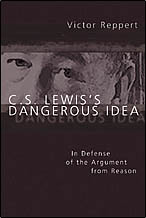
Lewis’s fundamental claim is that rational inference cannot be explained in purely naturalistic terms, and because it is obvious that rational inference does occur, that is a reason to reject naturalism. The title of the book is a self-confessed spin-off of Dennett’s book, Darwin’s Dangerous Idea. The deliberate connection in the title juxtaposes Dennett’s contention about the fundamental realities of reasoning and Lewis’s. Dennett argued that the best way to build knowledge was through the use of “cranes” and not “skyhooks.” Cranes are ideas and theories built on previous, naturalistically achieved, theories. A skyhook is a derogatory term for theories explained in terms of the supernatural or non-natural, and which, as the title implies, have no real grounding. Lewis’s contention is that there is something fundamental about the way reason works that turns Dennett’s idea on its head.
The first obstacle Reppert works to overcome is what he calls a biographical objection. He notes that many of the objections to Lewis’s philosophy are attacks on Lewis the person and not on his ideas. As legend has it, this argument of Lewis’s was once attacked and (apparently) trounced at a meeting by Elizabeth Anscombe. As the legend goes, Lewis basically gave up his apologetic writings after this apparent embarrassment. But as Reppert details, Lewis not only replied to Anscombe’s objections in an updated version of Miracles, Anscombe openly admitted that the second version was much more rigorous and harder to critique.
This section of the book was helpful to me in that I think many people’s objection to Lewis as a serious philosopher are biographical and not technical. His reputation as a favorite of evangelicals and as the author of children’s books has colored the view of many. In all honesty, I don’t see the need for the seeming bifurcation between serious thinker, religious thinker, and popular author. I think we need more serious and rigorous thinkers, not less, writing popular books than we might have now.
After a helpful chapter on apologetic arguments in which Reppert classifies Lewis as a “critical rationalist,” the philosophical defense begins in ernest. The first objections he deals with are the original objections posited by Anscombe. She critiqued Lewis’s original formulation by arguing that non-rational reasons may give rise to rational inference (Lewis originally used the term “irrational”), and that paradigm cases of reasoning may serve as an example of good and bad rational inference. Later in the book, Reppert continues to defend the argument from reason against more contemporary objectors. He deals with critiques concerning the explanatory power of non-physical causes, and what he calls the inadequacy objection.
Essentially, the inadequacy objection is that when naturalistic/materialistic reasons are found for any explanatory gap, they are the best and most sufficient explanations for phenomena. So, non-physical explanations, by their very nature, fall short. This chapter, along with its specific intent, provides a solid philosophical look into an answer to the “god-of-the-gaps” objection to theism.
Theism, and all the science and philosophy surrounding it, is often rejected as a point of view that will naturally be discarded when a better, materialistic, explanation is discovered. So is the case in this book with rational inference. Lewis and Reppert argue that it cannot be explained by naturalism, and thus is a reason to reject it. Naturalists reply that the non-natural explanation is a stopgap measure that will simply fade away when science has caught up with itself: we used to explain thunder as God doing something or other in the heavens, and now we know differently. It is, so the argument goes, the same with rational inference.
But Reppert’s point is that the argument from reason is no “god-of-the-gaps” argument. Instead of being an argument simply from an ignorance of natural explanation, it is a positive argument about the only good philosophical explanation for rational inference. In other words, if the argument from reason holds, there is logically no naturalistic explanation for the exercise of reason.
This same point can be made in the case of Intelligent Design, and recent work in the area of testable models of nature that infer (or abduct, if “abduct” is a verb) the existence of an intelligence. The straw man argument against ID is the claim that it is a “god-of-the-gaps” point of view that will disappear with the next scientific advancement. But that misses the point entirely. The point is the same as Reppert’s-if the argument holds, naturalism will never explain our origins or our apparent design.
I would highly recommend this book with one simple caveat: be prepared to think. It was a more philosophically rigorous book than I expected. I refuse to call this caveat a warning: it is a challenge and an encouragement to think a bit more deeply about Lewis, about apologetics, and about how your mental faculties work.
Saturday, December 10, 2005
Intelligent Design and the Role of Explanation
This is a wonderful example of apologetic interaction with the culture at large. It is an opinion piece written by Douglas Groothuis regarding the typical take on Intelligent Design in the Denver paper, The Rocky Mountain News. HT: World Mag Blog
One excerpt:
When Darwinists refuse to admit intelligent cause as a possible explanation for specified complexity, this only reveals that they define science such that intelligent causes are disallowed in principle. But this approach is not a discovery of science itself. It is rather a philosophical commitment to materialism (the belief that reality is reducible to impersonal physical laws).
This passage addresses one of the more crucial issues raised in opposition to ID. Often ID’s opponents will regard an explanation that goes beyond the natural/physical realm as no explanation at all. In other words, good explanations describe an event or process (or whatever) by other physical events, objects, processes, etc. Any attempt to produce an effective explanation outside the physical realm is an effort in futility. Non-natural explanations are not explanations at all. (See Victor Reppert’s book, C.S. Lewis’s Dangerous Idea for a developed engagement with this physicalist view of explanation.)
This view, though, reveals more about the typical assumptions built into the edifice of modern science than it does about the nature of explanation. If we begin with the assumption that physical causes are all that exist, then any attempt to explain data without appealing to other physical data will be dismissed out of hand. But, as Reppert points out in his philosophically rigorous book, exclusively physical explanations fall apart rather quickly.
If a naturalistic scientist is a fan of the N.Y Jets, his potential glee at them drafting a good quarterback next season is not at all explained by physical facts. Intent, belief, and other non-physical realities do a better job of explaining an emotion or reaction like glee than other, “lower down the chain,” physical explanations. Glee is not adequately described as having a causal chain beginning with neurons.
Analogously, for the scientific community to deny non-physical explanations for apparent design, is for them to say more about their philosophical presuppositions than their scientific rigor. And, as Dr. Groothuis points out in his article, it ends up being a straw man argument anyway.
One excerpt:
When Darwinists refuse to admit intelligent cause as a possible explanation for specified complexity, this only reveals that they define science such that intelligent causes are disallowed in principle. But this approach is not a discovery of science itself. It is rather a philosophical commitment to materialism (the belief that reality is reducible to impersonal physical laws).
This passage addresses one of the more crucial issues raised in opposition to ID. Often ID’s opponents will regard an explanation that goes beyond the natural/physical realm as no explanation at all. In other words, good explanations describe an event or process (or whatever) by other physical events, objects, processes, etc. Any attempt to produce an effective explanation outside the physical realm is an effort in futility. Non-natural explanations are not explanations at all. (See Victor Reppert’s book, C.S. Lewis’s Dangerous Idea for a developed engagement with this physicalist view of explanation.)
This view, though, reveals more about the typical assumptions built into the edifice of modern science than it does about the nature of explanation. If we begin with the assumption that physical causes are all that exist, then any attempt to explain data without appealing to other physical data will be dismissed out of hand. But, as Reppert points out in his philosophically rigorous book, exclusively physical explanations fall apart rather quickly.
If a naturalistic scientist is a fan of the N.Y Jets, his potential glee at them drafting a good quarterback next season is not at all explained by physical facts. Intent, belief, and other non-physical realities do a better job of explaining an emotion or reaction like glee than other, “lower down the chain,” physical explanations. Glee is not adequately described as having a causal chain beginning with neurons.
Analogously, for the scientific community to deny non-physical explanations for apparent design, is for them to say more about their philosophical presuppositions than their scientific rigor. And, as Dr. Groothuis points out in his article, it ends up being a straw man argument anyway.
Friday, December 09, 2005
Links Sans Context 12.9.05
Chad has some very thoughtful things to say in reply to Plantinga’s “Advice to Christian Philosophers.” It is a new blog to me and looks good.
Adrian is talking about Charismatic gifts and cessationism. He links to what looks to be a thoughtful article on the contemporary issue of prophecy.
Another new blog to me by Doug Wilson-this post deals well with McLaren’s A Generous Orthodxy.
Dr. Steve Cowan is writing a short series of posts on the role of apologetics and philosophy in the church. This post in particular is about their roles from behind the pulpit.
Darrell at Disert Paths is writing a series on Christian mysticism. This post has some good thoughts on the roles of small groups and Christian communities in directing mystical experience. We are beginning a conversation on the post-throw your hat in the ring. HT: Out In The Sticks
Steve has written another in his string on evangelical theology. Check out his thoughts on why evangelicalism might be so short on tools dealing with suffering.
Adrian is talking about Charismatic gifts and cessationism. He links to what looks to be a thoughtful article on the contemporary issue of prophecy.
Another new blog to me by Doug Wilson-this post deals well with McLaren’s A Generous Orthodxy.
Dr. Steve Cowan is writing a short series of posts on the role of apologetics and philosophy in the church. This post in particular is about their roles from behind the pulpit.
Darrell at Disert Paths is writing a series on Christian mysticism. This post has some good thoughts on the roles of small groups and Christian communities in directing mystical experience. We are beginning a conversation on the post-throw your hat in the ring. HT: Out In The Sticks
Steve has written another in his string on evangelical theology. Check out his thoughts on why evangelicalism might be so short on tools dealing with suffering.
Tuesday, December 06, 2005
Pastors and Plagiarism II
Rich at BlogRodent recently posed some thoughts on my post on pastors and plagiarism. I was forming this response when it became too ginormous for a comment. So here is the latest post on pastors and the problem(?) of plagiarism.
BTW-Rich is a former Chi Alpha minister-so am I. It is good to hear from another AGer and especially from someone who was part of one of the most dynamic and quality ministries in the AG!
Rich-
Thanks for your thoughts-they have been provocative and a great help for me in thinking through this issue. In fact, I have a few things to throw out there in reply.
Intent
I agree with you that because there is only so much Scripture and it is preached over so often, we are unlikely to “come up with anything new.” In fact, one of our tasks is to be dedicated to theological unoriginality. So, if I may not say anything genuinely original this weekend, what guidelines should I use to avoid plagiarism?
To begin with, I can’t be held responsible for citing someone I have not read. I may be responsible for reading the important scholars and pastors, but you cannot be culpable for something out of your control. I have never really read Tertullian, and am likely not to.
Intent is, I think, a big deal. My friend profited off of me when he could have called me and put me in touch with the editor. His motive was profit, and therefore wrong. If I borrow from the “masters” with the intent of sounding like a master without giving credit, I believe that intent makes it wrong.
More commonly, I think pastors borrow from other popular ministers because it cuts down on their prep time. In my opinion, that is a wrong intent. The primary job of the pastor is shepherd manifest most directly by theological and biblical leadership behind the pulpit. If I get another pastor to do that for me, that intent has made my action wrong.
If a pastor does their homework in study and prayer, and utilizes tools or skills from another, then there may not be plagiarism. As an example, I do not publicly credit my seminary teachers on a regular basis for the tools they gave me, or for pointing me in certain directions. (I do, however, credit them if I repeat something they said specifically or tended to say a lot-ut back to my point.) If I learn something in class about how the Greek language works or how a theological argument works, then I do not need to credit the tools I have been given. And most of the text in a commentary may fall into that general category. They are written to bring the pastor and student up to date on the latest take on the original languages. (But even then, if I borrow a specific or poignant thought from an exegetical commentary, I will cite it.) But if I read a book in preparation for a sermon and borrow an actual point made about an issue or a passage, I am bound to credit that person.
I just don’t think a pastor can or should gloss over plagiarism by appealing to the “it has already been done a million times” defense (not that you did that).
Spiritually Specific
I believe that we can hear or read points from another minister and use them to great effect in our congregations and their specific situation. But, it is negligent of a pastor to simply “use” another pastor’s material and hope it has the same effect for them it had for the original pastor and church. How many copy-cat churches have simply repeated Warren’s or Hybel’s sermon series because their churches got big using those sermons, and hopefully theirs will too?
Even if a pastor allows their sermons to be used as a kind of public domain, does that exempt the next pastor from the moral and spiritual requirement of connecting their passage, their God and their congregation on the weekend?
Academic Expectations vs. Pastoral Expectations
I can imagine some disagreeing with me by arguing that what is expected of a scholar writing an article is different from what might be expected from a pastor behind a pulpit. Though I would grant a few differences-there may not be the same expectation of universal familiarity with the average pastor-I think the principle still applies.
For example, a scholar who submits a paper for review will have it rejected if she cites a major figure or argument in the field and does not properly cite it. Likewise, if a minister manages to convince her congregation that she came up with the doctrine of the atonement, she has committed a serious sin.
Additionally, if we expect our scholars and “masters” to be rigorous, why should we expect our ministers to be sloppy?
Congregational Expectation
What is assumed by a congregation when they listen to their weekly sermon when it comes to plagiarism and citation? I do not mean to talk about what they actually expect-that is a statistical question-I mean what kinds of expectations are they due? Should they expect the sermon they are hearing to be a carbon copy of the latest and greatest sermonizer and his series from six weeks ago? Should they expect a sermon that is taken largely from another pastor’s sermon spoken at a conference last month? Should they expect their pastor to be producing largely “original” material taken from commentaries, books, conversations, current affairs, tools and skills learned in seminary, and their own spiritual lives?
Maybe I have stacked the questions a bit, but I think the answer is fairly clear.
BTW-Rich is a former Chi Alpha minister-so am I. It is good to hear from another AGer and especially from someone who was part of one of the most dynamic and quality ministries in the AG!
Rich-
Thanks for your thoughts-they have been provocative and a great help for me in thinking through this issue. In fact, I have a few things to throw out there in reply.
Intent
I agree with you that because there is only so much Scripture and it is preached over so often, we are unlikely to “come up with anything new.” In fact, one of our tasks is to be dedicated to theological unoriginality. So, if I may not say anything genuinely original this weekend, what guidelines should I use to avoid plagiarism?
To begin with, I can’t be held responsible for citing someone I have not read. I may be responsible for reading the important scholars and pastors, but you cannot be culpable for something out of your control. I have never really read Tertullian, and am likely not to.
Intent is, I think, a big deal. My friend profited off of me when he could have called me and put me in touch with the editor. His motive was profit, and therefore wrong. If I borrow from the “masters” with the intent of sounding like a master without giving credit, I believe that intent makes it wrong.
More commonly, I think pastors borrow from other popular ministers because it cuts down on their prep time. In my opinion, that is a wrong intent. The primary job of the pastor is shepherd manifest most directly by theological and biblical leadership behind the pulpit. If I get another pastor to do that for me, that intent has made my action wrong.
If a pastor does their homework in study and prayer, and utilizes tools or skills from another, then there may not be plagiarism. As an example, I do not publicly credit my seminary teachers on a regular basis for the tools they gave me, or for pointing me in certain directions. (I do, however, credit them if I repeat something they said specifically or tended to say a lot-ut back to my point.) If I learn something in class about how the Greek language works or how a theological argument works, then I do not need to credit the tools I have been given. And most of the text in a commentary may fall into that general category. They are written to bring the pastor and student up to date on the latest take on the original languages. (But even then, if I borrow a specific or poignant thought from an exegetical commentary, I will cite it.) But if I read a book in preparation for a sermon and borrow an actual point made about an issue or a passage, I am bound to credit that person.
I just don’t think a pastor can or should gloss over plagiarism by appealing to the “it has already been done a million times” defense (not that you did that).
Spiritually Specific
I believe that we can hear or read points from another minister and use them to great effect in our congregations and their specific situation. But, it is negligent of a pastor to simply “use” another pastor’s material and hope it has the same effect for them it had for the original pastor and church. How many copy-cat churches have simply repeated Warren’s or Hybel’s sermon series because their churches got big using those sermons, and hopefully theirs will too?
Even if a pastor allows their sermons to be used as a kind of public domain, does that exempt the next pastor from the moral and spiritual requirement of connecting their passage, their God and their congregation on the weekend?
Academic Expectations vs. Pastoral Expectations
I can imagine some disagreeing with me by arguing that what is expected of a scholar writing an article is different from what might be expected from a pastor behind a pulpit. Though I would grant a few differences-there may not be the same expectation of universal familiarity with the average pastor-I think the principle still applies.
For example, a scholar who submits a paper for review will have it rejected if she cites a major figure or argument in the field and does not properly cite it. Likewise, if a minister manages to convince her congregation that she came up with the doctrine of the atonement, she has committed a serious sin.
Additionally, if we expect our scholars and “masters” to be rigorous, why should we expect our ministers to be sloppy?
Congregational Expectation
What is assumed by a congregation when they listen to their weekly sermon when it comes to plagiarism and citation? I do not mean to talk about what they actually expect-that is a statistical question-I mean what kinds of expectations are they due? Should they expect the sermon they are hearing to be a carbon copy of the latest and greatest sermonizer and his series from six weeks ago? Should they expect a sermon that is taken largely from another pastor’s sermon spoken at a conference last month? Should they expect their pastor to be producing largely “original” material taken from commentaries, books, conversations, current affairs, tools and skills learned in seminary, and their own spiritual lives?
Maybe I have stacked the questions a bit, but I think the answer is fairly clear.
Openly Christian or Deeply Christian?
The recent popularity of The Lord of the Rings and now Narnia has spurred many conversations and articles about the “Christianity” of the books. While neither author made their worlds and fantasies explicitly Christian, (in fact, they both openly claimed the works were not attempts at Christian apologetics), there is no denying that the authors openly and unashamedly wrote from Christian worldviews and orthodox positions. Their theology made the worlds they created, and their worlds reflect the great themes and truths of the world the way God has created it.
The primary problem with spin-offs and much of Christian fiction today is that very little of it is as theologically informed as Middle Earth or the timeless Narnia. A good deal of it tries to cover up this foundational shortcoming by being explicitly Christian, but even then, without a sound and robust theological base, it fails to be enduring.
After a long battle over the rights to make the Narnia movies in a way true to the books, there are Narnia spin-offs appearing. “A Narnia Without Lewis or Aslan” deals with one such book. From the author near the end of the article:
Since we're supposing, I suppose that what would bother Lewis (and what should bother us) is not that the book isn't "Christian," but that it isn't any good. It's flat, predictable, and utterly undistinguished. It is hard to imagine that a story this lifeless would have been published had there been no Narnia hook.
This insightful quote points to an extremely important issue with Christian worldview living-the point is not to put a Christian veneer on a normal life, but to live a deep and meaningful Christian life wherever we happen to be. And in the case of literature, a children’s book that hopes to mimic the power of Lewis’ Narnia without the Christian worldview will fall flat, and a work that hopes to be Christian but relies only on the veneer will likely suffer the same fate.
The primary problem with spin-offs and much of Christian fiction today is that very little of it is as theologically informed as Middle Earth or the timeless Narnia. A good deal of it tries to cover up this foundational shortcoming by being explicitly Christian, but even then, without a sound and robust theological base, it fails to be enduring.
After a long battle over the rights to make the Narnia movies in a way true to the books, there are Narnia spin-offs appearing. “A Narnia Without Lewis or Aslan” deals with one such book. From the author near the end of the article:
Since we're supposing, I suppose that what would bother Lewis (and what should bother us) is not that the book isn't "Christian," but that it isn't any good. It's flat, predictable, and utterly undistinguished. It is hard to imagine that a story this lifeless would have been published had there been no Narnia hook.
This insightful quote points to an extremely important issue with Christian worldview living-the point is not to put a Christian veneer on a normal life, but to live a deep and meaningful Christian life wherever we happen to be. And in the case of literature, a children’s book that hopes to mimic the power of Lewis’ Narnia without the Christian worldview will fall flat, and a work that hopes to be Christian but relies only on the veneer will likely suffer the same fate.
Saturday, December 03, 2005
Planting Churches in Church-Sparse Areas
"Distant Neighbors" Gazette.com
I was interview recently by our local religion writer about the relative differences between Colorado Springs zip codes and the varying concentration of churches. The area we are planting in, the 80906 area in the article, is a fairly sever mixture of the wealthiest part of town and the most economically depressed area of town-and is the least populated by churches. Add to that a major Army base just one exit south on the highway and our downtown one exit north, and you have an interesting mission field.
I thought the article picked up on the issues well. The church planting "guru" quoted in the article, Steve Pike, was our local church planting director who helped us get Quail Lake started.
I would love to know some of your thoughts or experiences regarding planting churches in wealthy and/or economically depressed areas.
I was interview recently by our local religion writer about the relative differences between Colorado Springs zip codes and the varying concentration of churches. The area we are planting in, the 80906 area in the article, is a fairly sever mixture of the wealthiest part of town and the most economically depressed area of town-and is the least populated by churches. Add to that a major Army base just one exit south on the highway and our downtown one exit north, and you have an interesting mission field.
I thought the article picked up on the issues well. The church planting "guru" quoted in the article, Steve Pike, was our local church planting director who helped us get Quail Lake started.
I would love to know some of your thoughts or experiences regarding planting churches in wealthy and/or economically depressed areas.
Friday, December 02, 2005
How Do We Fix It?
In response to a recent post on Oprah and the kinds of spiritual role models our Christian culture has, Bob and Steve have posed some questions that are at the same time of terrific importance and terrifically difficult to deal with.
Bob said:
If our culture is in a negative level of spiritual interest and understanding, then what is the best tactic for moving it up into the positive? It can't be "talking above their heads," but it can't be capitulating to the ignorance either!
Steve said:
So my question after reading your post and Dr. Groothius': How do we change it? Whenever I criticize different teachers on TV or radio (Oprah, Joel Osteen, James Dobson) I am playing precious chips with my congregation. It seems they buy so much of this stuff hook, line, and sinker! How do we change that?
So the question stands: How do churches reach their people with a Christian worldview? The answer is clearly enormous, and all I want to do here is begin an engagement with a few thoughts that are hopefully just as practical as they are theoretical.
Worldview Teaching From The Pulpit
In my own sermonizing, I have found the worldview concept to be a helpful and fruitful tool. As I pour over a text and my notes, reflecting on how some specific biblical stories or concepts relate to a broader Christian worldview has enriched my own teaching (at least in my mind it has…). A pastor can never be in control of what people hear or absorb, but maybe we can be a little more deliberate about relating Christian worldview concepts to people. And of course, these concepts land most effectively when laypeople have a chance to engage them in their own lives.
For example, we recently went over Jeremiah 17:19-27 in which the prophet creates an image of crowded streets on the Sabbath and the rightful king’s inability to enter Jerusalem. As a result, the Sabbath concept we talked about was clearing our hearts and minds of the clutter of our pagan culture and freeing up our mental and spiritual attention for the rightful King.
A small step, admittedly, but most of them are.
Pastor as Thought Leader
This is a big-picture point, but an important one nonetheless. David Wells makes a devastating critique of the modern pastorate in his books No Place For Truth and God In The Wasteland in which he juxtaposes the community role of the pastor in early American and English Puritanism with that of the modern evangelical pastor. Suffice it to say the later does not stack up well. For good reasons and for not so good ones, the typical evangelical pastor is not seen as any kind of serious thought leader in their communities. As a result, people do not tend to think of the pastor or their pastor’s sermons and writings first when they do any kind of serious thinking about the world. They are much more likely to think of the talking heads on cable news or their favorite periodical.
The solution? Maybe we should expect pastors to be better educated, more well rounded, and more conversant with the important matters in life than many of them probably are. I suspect some pastors deserve the parochial image they have in the eyes of their congregation.
Just an initial set of thoughts to maybe get some juices flowing…
Bob said:
If our culture is in a negative level of spiritual interest and understanding, then what is the best tactic for moving it up into the positive? It can't be "talking above their heads," but it can't be capitulating to the ignorance either!
Steve said:
So my question after reading your post and Dr. Groothius': How do we change it? Whenever I criticize different teachers on TV or radio (Oprah, Joel Osteen, James Dobson) I am playing precious chips with my congregation. It seems they buy so much of this stuff hook, line, and sinker! How do we change that?
So the question stands: How do churches reach their people with a Christian worldview? The answer is clearly enormous, and all I want to do here is begin an engagement with a few thoughts that are hopefully just as practical as they are theoretical.
Worldview Teaching From The Pulpit
In my own sermonizing, I have found the worldview concept to be a helpful and fruitful tool. As I pour over a text and my notes, reflecting on how some specific biblical stories or concepts relate to a broader Christian worldview has enriched my own teaching (at least in my mind it has…). A pastor can never be in control of what people hear or absorb, but maybe we can be a little more deliberate about relating Christian worldview concepts to people. And of course, these concepts land most effectively when laypeople have a chance to engage them in their own lives.
For example, we recently went over Jeremiah 17:19-27 in which the prophet creates an image of crowded streets on the Sabbath and the rightful king’s inability to enter Jerusalem. As a result, the Sabbath concept we talked about was clearing our hearts and minds of the clutter of our pagan culture and freeing up our mental and spiritual attention for the rightful King.
A small step, admittedly, but most of them are.
Pastor as Thought Leader
This is a big-picture point, but an important one nonetheless. David Wells makes a devastating critique of the modern pastorate in his books No Place For Truth and God In The Wasteland in which he juxtaposes the community role of the pastor in early American and English Puritanism with that of the modern evangelical pastor. Suffice it to say the later does not stack up well. For good reasons and for not so good ones, the typical evangelical pastor is not seen as any kind of serious thought leader in their communities. As a result, people do not tend to think of the pastor or their pastor’s sermons and writings first when they do any kind of serious thinking about the world. They are much more likely to think of the talking heads on cable news or their favorite periodical.
The solution? Maybe we should expect pastors to be better educated, more well rounded, and more conversant with the important matters in life than many of them probably are. I suspect some pastors deserve the parochial image they have in the eyes of their congregation.
Just an initial set of thoughts to maybe get some juices flowing…
Christian Scholarship and The Authority of Scripture
I have just started reading “Shaping a Christian Worldview: The Foundations of Christian Education” by many of the faculty at Union University. The book is intended to be an engagement with the idea of higher education and its relationship to a Christian worldview. I must say, so far the work has been very thought provoking. One of the early essays tackles the problem of being a serious and rigorous scholar and holding to the authority of Scripture at the same time. Can believers in the ultimate authority of Scripture be academically rigorous and honest?
The author of the essay, George Guthrie makes a couple of helpful foundational remarks. First, the idea of any kind of authority from which scholars perform their work is more ubiquitous than many would admit. The accusation that Christians cannot perform scholarly duties honestly, leaves the clear implication that everyone else can because they are free from the fetters of a myopic authority structure. But, are they? What of postmodern deconstructionism, naturalism, Neo-Darwinian evolution, Marxism, etc.? Each of these paradigms acts as authority structures from which many scholars do their work and out of which many of them refuse (or fear to) stray. Christians are not the only scholars working from an authority structure.
Secondly, the implication is made that a Christian worldview and its authority structure is inherently at odds with the fruits of scholarly labor. Though much of fundamentalist isolationism in the past may have thought that and put that across to the rest of the world, good Christian theology has always taught the unity of truth: all truth is God’s truth. Christians can and should engage serious and honest work done in all fields of the academy with an eye to God’s truth.
Then Guthrie engages Grenz and the recent Postmodern turn in recent evangelical theology (so popular in many Emergent church circles). His critique of Grenz rests on a point I had never seen before. Guthrie states, “Grenz has moved his doctrine of Scripture out of a foundational position for doing theology to a subcategory of pneumatology, the doctrine of the Holy Spirit.” (28) Fascinating insight. What that means is that no longer is the message of Scripture a starting point in a Christian worldview, it is a result of various interpretive communities.
This, of course, falls prey to all the straightforward critiques of postmodernism. Why choose one community over another? Why believe there is any inherent, cross-cultural message in Scripture at all when another community might believe it is so much debris?
But in Guthrie’s assessment, another recent development in hermeneutics by Vanhoozer has helped solve some of those problems. Vanhoozer’s theory is a speech-act theory of interpretation in which God did deposit eternal truth in Scripture as He interacted with it, and as we interact with God’s speech, so to speak, we interpret and live out God’s deposited truth. (Doubtless this is a simple version of Vanhoozer’s thesis.)
The author of the essay, George Guthrie makes a couple of helpful foundational remarks. First, the idea of any kind of authority from which scholars perform their work is more ubiquitous than many would admit. The accusation that Christians cannot perform scholarly duties honestly, leaves the clear implication that everyone else can because they are free from the fetters of a myopic authority structure. But, are they? What of postmodern deconstructionism, naturalism, Neo-Darwinian evolution, Marxism, etc.? Each of these paradigms acts as authority structures from which many scholars do their work and out of which many of them refuse (or fear to) stray. Christians are not the only scholars working from an authority structure.
Secondly, the implication is made that a Christian worldview and its authority structure is inherently at odds with the fruits of scholarly labor. Though much of fundamentalist isolationism in the past may have thought that and put that across to the rest of the world, good Christian theology has always taught the unity of truth: all truth is God’s truth. Christians can and should engage serious and honest work done in all fields of the academy with an eye to God’s truth.
Then Guthrie engages Grenz and the recent Postmodern turn in recent evangelical theology (so popular in many Emergent church circles). His critique of Grenz rests on a point I had never seen before. Guthrie states, “Grenz has moved his doctrine of Scripture out of a foundational position for doing theology to a subcategory of pneumatology, the doctrine of the Holy Spirit.” (28) Fascinating insight. What that means is that no longer is the message of Scripture a starting point in a Christian worldview, it is a result of various interpretive communities.
This, of course, falls prey to all the straightforward critiques of postmodernism. Why choose one community over another? Why believe there is any inherent, cross-cultural message in Scripture at all when another community might believe it is so much debris?
But in Guthrie’s assessment, another recent development in hermeneutics by Vanhoozer has helped solve some of those problems. Vanhoozer’s theory is a speech-act theory of interpretation in which God did deposit eternal truth in Scripture as He interacted with it, and as we interact with God’s speech, so to speak, we interpret and live out God’s deposited truth. (Doubtless this is a simple version of Vanhoozer’s thesis.)
Monday, November 28, 2005
Pervasive Pastoral Plagiarism?
I was talking with a friend recently and he happened to mention that the senior pastor at his church “does Bill Hybels’ stuff” for his sermons. From time to time, I am impressed by how many pastors repeat or simply copy the sermons of famous pastors who sell or make their sermons generally available. Another friend of mine is a pastor of a mega-church and he has told the story a handful of times that his first few series were point for point right out of Rick Warren’s first series at Saddleback.
I am seriously wondering about the problem of plagiarism among pastors. Plagiarism is not only illegal, it is unethical and it is a fairly heinous sin. How many pastors even see things that way, and does the label “plagiarism” even apply to sermons?
I was plagiarized once. I had put together a detailed set of notes and handouts for an adult Bible study on Spiritual Formation. Unbeknownst to me, the tapes of the sessions were being shipped off to an associate pastor in another town (a good friend of mine, actually). He proceeded to teach the same series and received an offer to have an article on the subject published. In his words to me, “I was going to send him to you, but when I found out how much it paid, I went ahead and wrote the article.” That’s right-he actually conveyed the whole thing to me as if it were a funny anecdote.
What that told me then, and what I think has been confirmed several times since, is that many pastors don’t even know the word “plagiarism” much less are the capable of applying the concept to their sermonizing.
How should pastors apply the ethics of borrowing and citing sermons when so many of them are available for free (radio, internet, podcasting, etc.)?
To at least begin the reflection, I think it is incumbent upon pastors to do their own work for their congregation for their time and place. No doubt we will hear or read points that apply to our weekly sermons, but we need to be careful to attribute quotes, thoughts, or a train of thought.
One take on this issue is that it is simply lazy for a pastor to simply repeat someone else’s sermon. What about their role as prophet-as one who speaks for God to their congregation’s situation? That takes actual prayer and work, and pastors who fail to do that do a serious disservice to their flocks.
I am seriously wondering about the problem of plagiarism among pastors. Plagiarism is not only illegal, it is unethical and it is a fairly heinous sin. How many pastors even see things that way, and does the label “plagiarism” even apply to sermons?
I was plagiarized once. I had put together a detailed set of notes and handouts for an adult Bible study on Spiritual Formation. Unbeknownst to me, the tapes of the sessions were being shipped off to an associate pastor in another town (a good friend of mine, actually). He proceeded to teach the same series and received an offer to have an article on the subject published. In his words to me, “I was going to send him to you, but when I found out how much it paid, I went ahead and wrote the article.” That’s right-he actually conveyed the whole thing to me as if it were a funny anecdote.
What that told me then, and what I think has been confirmed several times since, is that many pastors don’t even know the word “plagiarism” much less are the capable of applying the concept to their sermonizing.
How should pastors apply the ethics of borrowing and citing sermons when so many of them are available for free (radio, internet, podcasting, etc.)?
To at least begin the reflection, I think it is incumbent upon pastors to do their own work for their congregation for their time and place. No doubt we will hear or read points that apply to our weekly sermons, but we need to be careful to attribute quotes, thoughts, or a train of thought.
One take on this issue is that it is simply lazy for a pastor to simply repeat someone else’s sermon. What about their role as prophet-as one who speaks for God to their congregation’s situation? That takes actual prayer and work, and pastors who fail to do that do a serious disservice to their flocks.
Sunday, November 27, 2005
Let The Christmas CDing Begin!
Every year, my lovely wife and I have our own little tradition of buying a new Christmas-themed CD. Some years are a hit, and others are, well, disappointments of a ginormous (to use a Ferrell neologism) proportion. This year’s selection is a kick in the pants. Dig That Crazy Christmas by The Brian Setzer Orchestra is a fun and upbeat rock-a-billy take on a lot of Christmas classics.
Inspired by Strong Bad’s “Bottom Ten,” I am inclined to list the top 6 Christmas CDs we own and the bottom two major disappointments.
Top 6:
1. When My Heart Finds Christmas, by Harry Connick Jr. Several numbers on this CD are making their way into the category of contemporary Christmas standards.
2. A Charlie Brown Christmas, by the Vince Guaraldi Trio. Good, simple combo work. This contains the original recording of “Linus and Lucy.” I have to admit my nostalgia probably pushes this up the rankings a bit.
3. A Dave Brubeck Christmas, by Dave Brubeck. Just a man and his piano.
4. Christmas Peace, by Elvis Presley. This is a 2-CD set of many of Elvis’ early gospel-style recordings of traditional Christmas hymns, as well as plenty of others. Some might find it a bit “campy,” but I enjoy it.
5. Harry for the Holidays, by Harry Connick Jr. Not as complete a CD as #1, but still a great addition to the collection.
6. Dig That Crazy Christmas, by The Brian Setzer Orchestra. It looks like this year was a hit!
Bottom 2:
2. Christmas With The Rat Pack. My overall reaction to this CD can be summed up with, “eh.” I had high hopes for this one, and very little of the CD lived up to them.
1. Celebrates A Gospel Christmas, by Ray Charles. Stay away-stay very far away. We bought this, again with high hopes, during the recent Ray Charles craze and were laughing all the way home. The recording is amateur, the choir is amateur, the drummer is really, really bad, and Ray sings on only a few of the tracks. Ouch!

Inspired by Strong Bad’s “Bottom Ten,” I am inclined to list the top 6 Christmas CDs we own and the bottom two major disappointments.
Top 6:
1. When My Heart Finds Christmas, by Harry Connick Jr. Several numbers on this CD are making their way into the category of contemporary Christmas standards.
2. A Charlie Brown Christmas, by the Vince Guaraldi Trio. Good, simple combo work. This contains the original recording of “Linus and Lucy.” I have to admit my nostalgia probably pushes this up the rankings a bit.
3. A Dave Brubeck Christmas, by Dave Brubeck. Just a man and his piano.
4. Christmas Peace, by Elvis Presley. This is a 2-CD set of many of Elvis’ early gospel-style recordings of traditional Christmas hymns, as well as plenty of others. Some might find it a bit “campy,” but I enjoy it.
5. Harry for the Holidays, by Harry Connick Jr. Not as complete a CD as #1, but still a great addition to the collection.
6. Dig That Crazy Christmas, by The Brian Setzer Orchestra. It looks like this year was a hit!
Bottom 2:
2. Christmas With The Rat Pack. My overall reaction to this CD can be summed up with, “eh.” I had high hopes for this one, and very little of the CD lived up to them.
1. Celebrates A Gospel Christmas, by Ray Charles. Stay away-stay very far away. We bought this, again with high hopes, during the recent Ray Charles craze and were laughing all the way home. The recording is amateur, the choir is amateur, the drummer is really, really bad, and Ray sings on only a few of the tracks. Ouch!
Saturday, November 26, 2005
Christian Carnival #97 Is Up
Thought Renewal: Christian Carnival #97, Part 2
Yours truly can be found in part 2 of this week's Christian Carnival. Way to go, Lyn Perry, for all the obvious hard work!
Yours truly can be found in part 2 of this week's Christian Carnival. Way to go, Lyn Perry, for all the obvious hard work!
Wednesday, November 23, 2005
Take Me To Your Leader-Or To Oprah...
Our local newspaper recently ran this article on Oprah as a kind of spiritual teacher in our age. My first reaction to these kinds of religious realities in our day and age involves a knot in my stomach and a growing sense of depression and inevitability. I find it extremely telling that many people find someone as religiously uncommitted and yet spiritually so public as Oprah to be their best spiritual guide. How did we get here?
I would not be surprised if the church has brought some of this upon itself. We have become so “relevant” to pop culture, I wonder if most simply don’t see a substantial difference between their local mega church and Oprah. Add to that the dismal statistics on the church’s trust level with the general populace, and you have a recipe for invisibility.
Additionally, it speaks to how shallow our culture at large has become. People no longer grasp the depth of spiritual and eternal issues, and they feel perfectly comfortable learning about them in the same places they learn decorating and personal hygiene tips.
UPDATE: Some further thoughts on the big O and the "theological stupification" of American christians can be found at the ever-thoughtful Culture Watch.
I would not be surprised if the church has brought some of this upon itself. We have become so “relevant” to pop culture, I wonder if most simply don’t see a substantial difference between their local mega church and Oprah. Add to that the dismal statistics on the church’s trust level with the general populace, and you have a recipe for invisibility.
Additionally, it speaks to how shallow our culture at large has become. People no longer grasp the depth of spiritual and eternal issues, and they feel perfectly comfortable learning about them in the same places they learn decorating and personal hygiene tips.
UPDATE: Some further thoughts on the big O and the "theological stupification" of American christians can be found at the ever-thoughtful Culture Watch.
Strike a Blow for Public Morality!
It is a small victory, but a victory nonetheless. The NFL arbirtator has upheld Owen's suspension from the Eagles. The kind of ego Owens is and respresents is a virus on culture.
Each and every mega-ego in the last handfull of years in the NFL has caused destruction to every team they have been on, and their careers have hit the toilet to join their personalities.
Where is Warren Sapp? If you have seen him, he belongs at Weight Watchers. Where is Keshawn "Just Give Me the D*** Ball" Johnson? Who cares anymore? What happened to Randy Moss? He is too concerned about his coiffure to run routes down the middle, so he is quickly fading into nothingness. And where will T.O. be next year? Wherever it is, I can guarantee now the cancer will follow.
Each and every mega-ego in the last handfull of years in the NFL has caused destruction to every team they have been on, and their careers have hit the toilet to join their personalities.
Where is Warren Sapp? If you have seen him, he belongs at Weight Watchers. Where is Keshawn "Just Give Me the D*** Ball" Johnson? Who cares anymore? What happened to Randy Moss? He is too concerned about his coiffure to run routes down the middle, so he is quickly fading into nothingness. And where will T.O. be next year? Wherever it is, I can guarantee now the cancer will follow.
Postmodern "Moral Reasoning"
I must admit that on my way home from teaching my Intro to Ethics class, I caught a portion of the Dennis Prager Show. For those of you who might despise talk radio, Prager is probably the most reasonable and clear-headed host out there, and one who could easily stand on his own outside of the talk show format. In any event, he was interviewing Chris Matthews of Hardball fame about a recent speech of his at the University of Toronto. Some of his comments on Islamofacism and the Iraq war have caused a bit of a stir. The most prominent of them being:
"The period between 9-11 and (invading) Iraq was not a good time for America. There wasn't a robust discussion of what we were doing," Matthews said. "If we stop trying to figure out the other side, we've given up. The person on the other side is not evil. They just have a different perspective.”
What I was privy to on the Prager show expanded on his point. Matthews argued that the wrong moral stance to take in the face of Islamic absolutism was moral absolutism. In his opinion, the right response to moral absolutism was moral “fuzziness” (his word) and a refusal to label them in any significant moral way. He had his own convoluted version of “If you do X, you are with the terrorists.” He kept on arguing that reacting with moral judgment is exactly what the Islamofascists wanted and they were getting it because we have labeled them as evil.
And, in typical postmodern fashion, Matthews kept on arguing with Prager that we can only think and act in “tribal” ways and we don’t have the ability to reason morally outside our tribes.
In reaction to Matthews, listen to this quote from the J.P. Moreland article cited below:
I am…convinced that postmodernism is an irresponsible, cowardly abrogation of the intellectual duties that constitute a disciple’s calling to be a Christian intellectual and teacher….Faced with such opposition [intellectual differences] and the pressure it brings, postmodernism is a form of intellectual pacifism that, at the end of the day, recommends backgammon while the barbarians are at the gate. It is the easy, cowardly way out that removes the pressure to engage alternative conceptual schemes, to be different, to risk ridicule, to take a stand outside the gate. (Journal of the Evangelical Theological Society. Vol 48, No. 1. pp. 87-88)
To apply Moreland’s basic complaint ethically, not only is it a faulty ethical strategy to react to moral evil with moral timidity, it is itself immoral. It is not, as many postmoderns claim, morally superior to refuse to draw a line in the sand. It is cowardly. Certainly there is room for “understanding” moral evil, but the wrong conclusion is that understanding those who are different from us should result in a refusal to morally categorize their behavior. For Matthews, and so many others like him, the “understanding” move is a “get out of moral reasoning free” card.
"The period between 9-11 and (invading) Iraq was not a good time for America. There wasn't a robust discussion of what we were doing," Matthews said. "If we stop trying to figure out the other side, we've given up. The person on the other side is not evil. They just have a different perspective.”
What I was privy to on the Prager show expanded on his point. Matthews argued that the wrong moral stance to take in the face of Islamic absolutism was moral absolutism. In his opinion, the right response to moral absolutism was moral “fuzziness” (his word) and a refusal to label them in any significant moral way. He had his own convoluted version of “If you do X, you are with the terrorists.” He kept on arguing that reacting with moral judgment is exactly what the Islamofascists wanted and they were getting it because we have labeled them as evil.
And, in typical postmodern fashion, Matthews kept on arguing with Prager that we can only think and act in “tribal” ways and we don’t have the ability to reason morally outside our tribes.
In reaction to Matthews, listen to this quote from the J.P. Moreland article cited below:
I am…convinced that postmodernism is an irresponsible, cowardly abrogation of the intellectual duties that constitute a disciple’s calling to be a Christian intellectual and teacher….Faced with such opposition [intellectual differences] and the pressure it brings, postmodernism is a form of intellectual pacifism that, at the end of the day, recommends backgammon while the barbarians are at the gate. It is the easy, cowardly way out that removes the pressure to engage alternative conceptual schemes, to be different, to risk ridicule, to take a stand outside the gate. (Journal of the Evangelical Theological Society. Vol 48, No. 1. pp. 87-88)
To apply Moreland’s basic complaint ethically, not only is it a faulty ethical strategy to react to moral evil with moral timidity, it is itself immoral. It is not, as many postmoderns claim, morally superior to refuse to draw a line in the sand. It is cowardly. Certainly there is room for “understanding” moral evil, but the wrong conclusion is that understanding those who are different from us should result in a refusal to morally categorize their behavior. For Matthews, and so many others like him, the “understanding” move is a “get out of moral reasoning free” card.
Monday, November 21, 2005
The Things We Think Are Biblical
I have thought a lot about the dismal statistics concerning our basic biblical illiteracy. It doesn’t take long to run into some pretty depressing numbers, and most depressing is the reality that the numbers inside the church are not all that different than the numbers outside the church.
Recently, though, one specific stat caught my eye in a new way. Barna’s research has revealed that 82% of the population believes that “God helps those who help themselves” is in the Bible, and that in the church we have been able to correct that false notion by one percent. As another one of Barna’s studies puts it:
This not only speaks to our basic lack of knowledge, but to what we think is biblically sanctioned. We Americans have been inoculated with an individualistic and entrepreneurial attitude to the point where we have equated a secular, pagan value with our Christian values. God not only is not in the business of helping those who help themselves, He is actually in the business of reminding us how utterly incapable of taking care of ourselves we really are.
The proper counter-move to this false idea is twofold: an understanding of original sin and the extent of total depravity, and an understanding of the absolute freedom there is to be found in trust in God.
Psalm 1 says:
Blessed is the man
who walks not in the counsel of the wicked,
nor stands in the way of sinners,
nor sits in the seat of scoffers;
but his delight is in the law of the LORD,
and on his law he meditates day and night.
He is like a tree
planted by streams of water
that yields its fruit in its season,
and its leaf does not wither.
In all that he does, he prospers.
The wicked are not so,
but are like chaff that the wind drives away.
Jeremiah 17 echoes this truth and explains why we cannot trust in human hearts (including my own!):
Cursed is the man who trusts in man
and makes flesh his strength,
whose heart turns away from the LORD....
The heart is deceitful above all things,
and desperately sick;
who can understand it?
Our trust in our abilities is too great. Our strengths and potentialities far underdetermine the trust we put in ourselves. That is a recipe for disaster.
Recently, though, one specific stat caught my eye in a new way. Barna’s research has revealed that 82% of the population believes that “God helps those who help themselves” is in the Bible, and that in the church we have been able to correct that false notion by one percent. As another one of Barna’s studies puts it:
The most widely-known Bible verse among adult and teen believers is "God helps those who help themselves"…
This not only speaks to our basic lack of knowledge, but to what we think is biblically sanctioned. We Americans have been inoculated with an individualistic and entrepreneurial attitude to the point where we have equated a secular, pagan value with our Christian values. God not only is not in the business of helping those who help themselves, He is actually in the business of reminding us how utterly incapable of taking care of ourselves we really are.
The proper counter-move to this false idea is twofold: an understanding of original sin and the extent of total depravity, and an understanding of the absolute freedom there is to be found in trust in God.
Psalm 1 says:
Blessed is the man
who walks not in the counsel of the wicked,
nor stands in the way of sinners,
nor sits in the seat of scoffers;
but his delight is in the law of the LORD,
and on his law he meditates day and night.
He is like a tree
planted by streams of water
that yields its fruit in its season,
and its leaf does not wither.
In all that he does, he prospers.
The wicked are not so,
but are like chaff that the wind drives away.
Jeremiah 17 echoes this truth and explains why we cannot trust in human hearts (including my own!):
Cursed is the man who trusts in man
and makes flesh his strength,
whose heart turns away from the LORD....
The heart is deceitful above all things,
and desperately sick;
who can understand it?
Our trust in our abilities is too great. Our strengths and potentialities far underdetermine the trust we put in ourselves. That is a recipe for disaster.
Thursday, November 17, 2005
J.P. Moreland: Postmodernism & Truth - Apologia Christi
J.P. Moreland: Postmodernism & Truth - Apologia Christi
I wanted to give a link to Apoligia Christi for posting this snippit of Moreland's recent article on Postmodernism and truth. It is being publised along with a handful of other essays on the topic in the book Whatever Happened to Truth?. The other essayists include Albert Mohler and Kevin Vanhoozer.
The excerpt AC quotes is priceless. As a teaser:
"...postmodernism is an immoral and cowardly viewpoint such that persons who love truth and knowledge, especially disciples of the Lord Jesus, should do everything they can to heal the plague that postmoernism has and inevitably does leave...."
Well...at least you know where he stands on the issue.
I wanted to give a link to Apoligia Christi for posting this snippit of Moreland's recent article on Postmodernism and truth. It is being publised along with a handful of other essays on the topic in the book Whatever Happened to Truth?. The other essayists include Albert Mohler and Kevin Vanhoozer.
The excerpt AC quotes is priceless. As a teaser:
"...postmodernism is an immoral and cowardly viewpoint such that persons who love truth and knowledge, especially disciples of the Lord Jesus, should do everything they can to heal the plague that postmoernism has and inevitably does leave...."
Well...at least you know where he stands on the issue.
Wednesday, November 16, 2005
A New Kind of Reaction
There has been an experiment in book blooging going on at A New Kind of Conversation. It has been fun and interesting to watch it develop and grow, and I hope its format will prompt other book styled blogs in the future.
I have been watching and reading closely (for the most part) the emergent and postmodern themes with great interest and a recent post on Postmodernism and Apologetics has caught my eye in several ways. So you may have to forgive the tongue-in-cheek title to the post, but it is intended with respect to the work done on the blog.
Myron Penner titles his post “Postmodern Apologetics?” and lays out his argument for how apologetics ought to morph given the realities of our new pomo world. First I want to note that I agree with much of the focus and tone of the post. His emphasis on apologetics being about people and not arguments will receive no criticism from me, and his view that Paul and the apostles relied on the power of the Holy Spirit more than their native reasoning capacities will receive the same assent. What I do want to note, though, are ideas that seem ubiquitous in emergent writing on modernity vs. postmoderninty. The fundamental problems with the emergent critique and subsequently with their conclusions are: false dichotomies (what Carson calls “wretched antitheses”), straw men, and “being hoisted by their own petards.” The best way to go at this is to reply to a few sections of the post.
Penner writes:
Søren Kierkegaard is the first modern thinker to perceive the deep-seated disparity between the modern scientific paradigm and biblical Christianity, and he subsequently argues vigorously that Christianity cannot be assimilated to modern science and philosophy as modern apologists wish.
I am not intimately familiar with all the standard apologists of the 19th and 20th centuries, but I am not sure of whom he speaks. The apologists I am familiar with, many of whom can be easily recognized as carrying the evidentialist or classical flags of modern apologetics, do not wish the assimilation of the faith to science. There is a fundamental difference between using the tools provided by modernism and science and wishing your faith’s assimilation to them.
Do any of the emergent writers wish the assimilation of their faith to Postmodernism? Do they want to use the alleged tools provided by postmodern critique, and would they balk at the notion that their usage of those tools entails their assimilation to a fundamentally thin philosophy? The answer to both issues is more than likely “yes.” And if so, you cannot have it both ways: if you can use tools from your toolbox without being assimilated, another thinker can do the same.
Penner continues:
From the Christian point of view, the truth about Christianity cannot be found in modern-styled objectivity. Not only does the essence of Christianity concern the desperate need of humans and God’s gracious (and personal) response to our need, but it also starts with the assumption that human being (including human reason) is unable to save itself. Christian truth presumes to master us, rather than to be mastered by us. In this case, whenever I try to establish the fundamental reasonability of Christianity in modern terms I remove its fundamental “offense” to reason and transform Christianity into something domestic, with nothing other than a cognitive claim on my life.
It may be true that the truth about Christianity cannot be found in modern-styled objectivity, but that is a heavily loaded sentence. What does “found in” mean? Does it mean “completely encompassed by”? If so, then he is probably right, and again, I don’t know of any serious apologist who would disagree. Does it mean modern-style objectivity “cannot capture any significant truth”? Given the rest of the essay, I doubt this is what he means, but if it is close, I think it is false. “God exists” is not only a proposition that carries existential weight (per postmodern apologetics), but it is a proposition that conveys a truth statement about the way the universe actually is regardless of any existential assent. It is objective (objectively true or false).
I do agree that there have been threads of apologetic teaching and training (maybe substantial threads) in the American church that have assumed a kind of “cognitive-alone” approach to belief, and he is right that that needs to be corrected.
Penner writes:
Christianity, however, is a way of being, or what Kierkegaard calls an “actuality”—a way of living with and before God—and not just a cognitive event involving intellectual assent to a set of propositions. It involves the acts of God Himself in response to our condition as sinful persons and requires our being saved from this condition of brokenness and sinfulness through a total response that can only be described in theological categories like sin, repentance, and salvation the necessarily relate to the subjectivity of human being. These personal categories cannot be assimilated into the objective discourse of modern science and point to subjective realities that are more appropriately dealt with in sermons.
Until that last sentence, hear a hearty “amen.” But that last sentence seems to assume things about contemporary apologetics that do not seem to me to be true. First, I am not sure that the implied equation between “science” and modern apologetics is fair. Using “science” in the place of “apologetics” communicates falsehoods about the goals and means of modern apologetics and attempts to communicate things about apologetics that are not the case.
It is true that the personal nature of belief and spiritual experience cannot be assimilated into “science,” but it is not true that it cannot be adequately handled by modern apologetics. I have cut my apologetic teeth on some of the grandest alleged perpetrators of modern apologetics, and I have always been reminded in their writings and their lectures that people and their real lives are at the core of what they do.
Even more Penner:
I also want briefly to mention one other important problem with using modern (objective and universal) apologetic arguments to defend Christianity, though there are others as well. Modern objectivity refuses to acknowledge the ethical dimensions of arguments, and treats them abstractly and a-contextually, and ignores the personal and social dimension of reason.
Again, I think this is an unfair equating of “science” and “apologetics.” Some of the best known modern apologists have argued for God’s existence and His moral ordering of the human existence using the undeniable ethical realities of our lives. As an entire branch of theology and philosophy of religion, Natural Law, is often used as a tool with which to engage the ethical structure of life.
I can’t stop quoting!
Arguments never mean anything until they are used by persons in a social context to do something, and one may use a perfectly valid argument with all true premises to do something unethical (like, for example, belittle or domineer someone). A modern, objective approach to apologetic arguments also inclines Christian apologists to overlook the fact that their arguments may be used to support an oppressive and socially unjust form of Christianity, and therefore to that degree fail to justify actual Christianity.
I want to address two things in this excerpt. First, arguments do mean something before they are “lived out.” As above, an argument for the proposition “God exists” carries value that transcends any and all existential reaction. What I think Penner intends to convey is that those arguments do not take root in our lives and belief systems until we are ready to pattern our lives after them. And with that kind of assertion I can readily agree.
Secondly, in response to the argument that modern apologetic approaches can lead to oppressive forms of Christianity, the best response is, “so what?” Literally anything can be used as a justification for oppression, including the rampant “political correctness” foisted on all of us and propped up by postmodern sensibilities. Should we then reject those sensibilities for exactly the same reason? That argument against modern apologetics proves nothing.
Give yourself five extra-credit points if you are still with me:
But what if we modeled our apologetic heroes after apostles and not analytic philosophers? What if we made love, and not modern rationality, the hallmark of our defense of Christianity, and took kerygma, not logic, as the form of our apologetic discourse?
This is a clear example of a false dichotomy. Modern rationality does not necessarily exclude love, and kerygma does not trump logic.
Penner concludes his post by outlining a positive approach to what he envisions as a good postmodern apologetic. It is late and any further thoughts on his post will need to wait.
I have been watching and reading closely (for the most part) the emergent and postmodern themes with great interest and a recent post on Postmodernism and Apologetics has caught my eye in several ways. So you may have to forgive the tongue-in-cheek title to the post, but it is intended with respect to the work done on the blog.
Myron Penner titles his post “Postmodern Apologetics?” and lays out his argument for how apologetics ought to morph given the realities of our new pomo world. First I want to note that I agree with much of the focus and tone of the post. His emphasis on apologetics being about people and not arguments will receive no criticism from me, and his view that Paul and the apostles relied on the power of the Holy Spirit more than their native reasoning capacities will receive the same assent. What I do want to note, though, are ideas that seem ubiquitous in emergent writing on modernity vs. postmoderninty. The fundamental problems with the emergent critique and subsequently with their conclusions are: false dichotomies (what Carson calls “wretched antitheses”), straw men, and “being hoisted by their own petards.” The best way to go at this is to reply to a few sections of the post.
Penner writes:
Søren Kierkegaard is the first modern thinker to perceive the deep-seated disparity between the modern scientific paradigm and biblical Christianity, and he subsequently argues vigorously that Christianity cannot be assimilated to modern science and philosophy as modern apologists wish.
I am not intimately familiar with all the standard apologists of the 19th and 20th centuries, but I am not sure of whom he speaks. The apologists I am familiar with, many of whom can be easily recognized as carrying the evidentialist or classical flags of modern apologetics, do not wish the assimilation of the faith to science. There is a fundamental difference between using the tools provided by modernism and science and wishing your faith’s assimilation to them.
Do any of the emergent writers wish the assimilation of their faith to Postmodernism? Do they want to use the alleged tools provided by postmodern critique, and would they balk at the notion that their usage of those tools entails their assimilation to a fundamentally thin philosophy? The answer to both issues is more than likely “yes.” And if so, you cannot have it both ways: if you can use tools from your toolbox without being assimilated, another thinker can do the same.
Penner continues:
From the Christian point of view, the truth about Christianity cannot be found in modern-styled objectivity. Not only does the essence of Christianity concern the desperate need of humans and God’s gracious (and personal) response to our need, but it also starts with the assumption that human being (including human reason) is unable to save itself. Christian truth presumes to master us, rather than to be mastered by us. In this case, whenever I try to establish the fundamental reasonability of Christianity in modern terms I remove its fundamental “offense” to reason and transform Christianity into something domestic, with nothing other than a cognitive claim on my life.
It may be true that the truth about Christianity cannot be found in modern-styled objectivity, but that is a heavily loaded sentence. What does “found in” mean? Does it mean “completely encompassed by”? If so, then he is probably right, and again, I don’t know of any serious apologist who would disagree. Does it mean modern-style objectivity “cannot capture any significant truth”? Given the rest of the essay, I doubt this is what he means, but if it is close, I think it is false. “God exists” is not only a proposition that carries existential weight (per postmodern apologetics), but it is a proposition that conveys a truth statement about the way the universe actually is regardless of any existential assent. It is objective (objectively true or false).
I do agree that there have been threads of apologetic teaching and training (maybe substantial threads) in the American church that have assumed a kind of “cognitive-alone” approach to belief, and he is right that that needs to be corrected.
Penner writes:
Christianity, however, is a way of being, or what Kierkegaard calls an “actuality”—a way of living with and before God—and not just a cognitive event involving intellectual assent to a set of propositions. It involves the acts of God Himself in response to our condition as sinful persons and requires our being saved from this condition of brokenness and sinfulness through a total response that can only be described in theological categories like sin, repentance, and salvation the necessarily relate to the subjectivity of human being. These personal categories cannot be assimilated into the objective discourse of modern science and point to subjective realities that are more appropriately dealt with in sermons.
Until that last sentence, hear a hearty “amen.” But that last sentence seems to assume things about contemporary apologetics that do not seem to me to be true. First, I am not sure that the implied equation between “science” and modern apologetics is fair. Using “science” in the place of “apologetics” communicates falsehoods about the goals and means of modern apologetics and attempts to communicate things about apologetics that are not the case.
It is true that the personal nature of belief and spiritual experience cannot be assimilated into “science,” but it is not true that it cannot be adequately handled by modern apologetics. I have cut my apologetic teeth on some of the grandest alleged perpetrators of modern apologetics, and I have always been reminded in their writings and their lectures that people and their real lives are at the core of what they do.
Even more Penner:
I also want briefly to mention one other important problem with using modern (objective and universal) apologetic arguments to defend Christianity, though there are others as well. Modern objectivity refuses to acknowledge the ethical dimensions of arguments, and treats them abstractly and a-contextually, and ignores the personal and social dimension of reason.
Again, I think this is an unfair equating of “science” and “apologetics.” Some of the best known modern apologists have argued for God’s existence and His moral ordering of the human existence using the undeniable ethical realities of our lives. As an entire branch of theology and philosophy of religion, Natural Law, is often used as a tool with which to engage the ethical structure of life.
I can’t stop quoting!
Arguments never mean anything until they are used by persons in a social context to do something, and one may use a perfectly valid argument with all true premises to do something unethical (like, for example, belittle or domineer someone). A modern, objective approach to apologetic arguments also inclines Christian apologists to overlook the fact that their arguments may be used to support an oppressive and socially unjust form of Christianity, and therefore to that degree fail to justify actual Christianity.
I want to address two things in this excerpt. First, arguments do mean something before they are “lived out.” As above, an argument for the proposition “God exists” carries value that transcends any and all existential reaction. What I think Penner intends to convey is that those arguments do not take root in our lives and belief systems until we are ready to pattern our lives after them. And with that kind of assertion I can readily agree.
Secondly, in response to the argument that modern apologetic approaches can lead to oppressive forms of Christianity, the best response is, “so what?” Literally anything can be used as a justification for oppression, including the rampant “political correctness” foisted on all of us and propped up by postmodern sensibilities. Should we then reject those sensibilities for exactly the same reason? That argument against modern apologetics proves nothing.
Give yourself five extra-credit points if you are still with me:
But what if we modeled our apologetic heroes after apostles and not analytic philosophers? What if we made love, and not modern rationality, the hallmark of our defense of Christianity, and took kerygma, not logic, as the form of our apologetic discourse?
This is a clear example of a false dichotomy. Modern rationality does not necessarily exclude love, and kerygma does not trump logic.
Penner concludes his post by outlining a positive approach to what he envisions as a good postmodern apologetic. It is late and any further thoughts on his post will need to wait.
Links Sans Context, 11.17.05
Steve continues to amaze me with his ability to stay on the bleeding edge of web technologies. He has a provocative post on meditation and brain health at Out In The Sticks. It is a wonderful place to beging thinking about what is Christian meditation and how it is/may be different than other forms. Great new look, by the way!
Jeff at Dawn Treader concludes his conversation with a molecular biologist. If only we all were as proficient in our blogging as he...
Between Two Worlds posts on the controversial issue of evil and the existence of God. I have run across a few who have made the argument that the existence of evil is actually a kind of argument for God's existence, and BTW deals with William Lane Craig's version.
My old blogging buddy Bob at Vanguard Church Blog reminded me of the New Kind of Conversation blog book by posting on Postmodern Apologetics. Check it out and join the conversation.
I recently reviewed Piper's book God Is The Gospel. Scot McKnight deals with it and his experiences with Piper. It is worth a read.
And as a second mention, I look forward with great anticipation to the future of my friend's new blog Is This Thing On?
Jeff at Dawn Treader concludes his conversation with a molecular biologist. If only we all were as proficient in our blogging as he...
Between Two Worlds posts on the controversial issue of evil and the existence of God. I have run across a few who have made the argument that the existence of evil is actually a kind of argument for God's existence, and BTW deals with William Lane Craig's version.
My old blogging buddy Bob at Vanguard Church Blog reminded me of the New Kind of Conversation blog book by posting on Postmodern Apologetics. Check it out and join the conversation.
I recently reviewed Piper's book God Is The Gospel. Scot McKnight deals with it and his experiences with Piper. It is worth a read.
And as a second mention, I look forward with great anticipation to the future of my friend's new blog Is This Thing On?
Monday, November 14, 2005
Building Character, Shaping a Life
The longer I live, the more I am convinced by the idea that the virtues we build into our lives affect the ways in which we know the world. Academically, this is often called virtue epistemology, but I think there is a strong biblical foundation for this notion as well. The more virtue we have in our lives the clearer we see the world and our proper places in it, and the more vice we have in our lives, the more cloudy our vision of Christ and our relationships become. In time I hope to deal with a few of the traditional virtues one by one, but to begin making my case, I want to cite a couple of biblical passages. First, Malachi 3:13-15:
"Your words have been hard against me, says the LORD. But you say, 'How have we spoken against you?' You have said, 'It is vain to serve God. What is the profit of our keeping his charge or of walking as in mourning before the LORD of hosts? And now we call the arrogant blessed. Evildoers not only prosper but they put God to the test and they escape.'"
This kind of conversation occurs a lot in the OT, and relatively often in the short book of Malachi. So what does it indicate? It shows, and I picked this instance because of its clarity, that those living in rebellion against God don’t have the moral wherewithal to see it. Sin has deadened their moral senses. In my own semi-technical short-hand translation of the Hebrew, the conversation goes like this:
God says, "You have told people to disdain me."
The people respond, "How have we told people to disdain you?"
God hits "play" on the DVD and we watch as the people say, "You should disdain God."
A supporting passage in the NT can be found in 1 John 2:11:
But whoever hates his brother is in the darkness and walks in the darkness, and does not know where he is going, because the darkness has blinded his eyes.
It is not just that when we are sinning we are sinning. Our sins actually blind us to the moral structure of the universe-they "turn out the light" so to speak.
The inoculation of virtue into our characters is more than a matter of looking like Mother Teresa-it is a means by which we can better grasp the world around us and the spiritual realities of God and His creation. You want to have a better ethical and epistemological grasp of things? Become more loving, humble, courageous, chaste, hopeful, temperate, more just.
"Your words have been hard against me, says the LORD. But you say, 'How have we spoken against you?' You have said, 'It is vain to serve God. What is the profit of our keeping his charge or of walking as in mourning before the LORD of hosts? And now we call the arrogant blessed. Evildoers not only prosper but they put God to the test and they escape.'"
This kind of conversation occurs a lot in the OT, and relatively often in the short book of Malachi. So what does it indicate? It shows, and I picked this instance because of its clarity, that those living in rebellion against God don’t have the moral wherewithal to see it. Sin has deadened their moral senses. In my own semi-technical short-hand translation of the Hebrew, the conversation goes like this:
God says, "You have told people to disdain me."
The people respond, "How have we told people to disdain you?"
God hits "play" on the DVD and we watch as the people say, "You should disdain God."
A supporting passage in the NT can be found in 1 John 2:11:
But whoever hates his brother is in the darkness and walks in the darkness, and does not know where he is going, because the darkness has blinded his eyes.
It is not just that when we are sinning we are sinning. Our sins actually blind us to the moral structure of the universe-they "turn out the light" so to speak.
The inoculation of virtue into our characters is more than a matter of looking like Mother Teresa-it is a means by which we can better grasp the world around us and the spiritual realities of God and His creation. You want to have a better ethical and epistemological grasp of things? Become more loving, humble, courageous, chaste, hopeful, temperate, more just.
Saturday, November 12, 2005
Book Review: God Is The Gospel, by John Piper
I am not an old man, and I have only been pastoring for a little over a decade, but I am already weary with the evangelical church’s thirst for relevance. There is a clear biblical mandate to make disciples, preach the Gospel to every nation, and to become all things to all people, but far too often, the form that takes is one that gives up too much theologically. We are too prone to neglect the core realities of the Gospel of Christ in our pursuit to make it palatable to the rest of the world.
John Piper’s God Is the Gospel is a candle in the doctrinal darkness that we seem to be in far too often. Piper’s call in this small but thoughtful book is to reestablish God as the center of his good news-God gave us himself because he is the best thing we could be given. Right from the very beginning, the Reformation theology Piper is so famous for is right on the surface and clearly guiding his work. I do not consider myself particularly reformed, but I appreciated deeply the God-centered focus of the book and Piper’s willingness to be theologically straightforward.
On the opening page, Piper’s focus is clear, “The acid test of biblical God-centeredness-and faithfulness to the gospel-is this: Do you feel more loved because God makes much of you, or because, as the cost of his Son, he enables you to enjoy making much of him forever?” (11). This sentiment sets the tone for the rest of the book. Piper does not deny that we take great joy in our salvation and that God does make much of us, but the purpose and progression of sanctification should lead us to the reality that the greatest joy we can have is making much of him. Not long after this thesis statement, Piper explains what he means with the phrase “God Is the Gospel,” “When I say, God Is the Gospel I mean that the highest, best, final, decisive good of the gospel, without which no other gifts would be good, is the glory of God in the face of Christ revealed for our everlasting enjoyment.” (13)
Through much of the rest of the book, Piper focuses on this theme of the glory of God revealed in Christ. Though the biblical notion of the “glory of God” can be wide-ranging and difficult to pin-down in an easy to grasp fashion at times, Piper does a wonderful job of explicating the notion and encouraging the reader to take pleasure in God and his glory.
Though it is not an academic work, it is well cited and researched. His ability to be conversant with the Puritans was clear, and I appreciate the way he quoted and handled Edwards. It is good for us pastors and contemporary Christians to be reminded that we have a rich and “relevant” theological history that back beyond a couple of decades. The theologian Thomas Oden has written that he has become hesitant to, “trust anyone under ‘three hundred’,” and that he believes “[w]e should be passionately dedicated to unoriginality.”[i] I believe Piper would add a hearty “amen!”
If there are any drawbacks to God Is the Gospel, they would be in its chapter and section format. Though I believe that chapters broken into smaller sections can aid a reader, especially a busy reader, there were too many sections within chapters that were too small. At times, there were as many as four sections on a set of opposing pages, and from time to time their proliferation became a hindrance to the flow of the argument.
But ultimately, that is a small matter. I would heartily recommend God Is the Gospel as a wonderful and rich reminder of the core of our lives and the life of the Church: the glory of Christ in his gospel.
I would like to thank Mind and Media for the opportunity to review this work, and Crossway Books for the complimentary copy.
[i] Guinness, Os and John Steel, eds. No God But God. (Moody Press, Chicago: 1992). pg. 191, 200.
Friday, November 11, 2005
I Got Sloganized!
Slogans-our friend or foe? We are marketed to in slogans, we are told what politicians think in slogans, we are told how to vote in slogans, we are informed about the rest of the world in slogans, churches market in slogans…surely they are a useful tool?
I don’t think so. I have taken to the rather useful habit of labeling something a “slogan” if it is a useless bite-sized piece of information which is, on the surface of things, intended to convey information, but in actuality ends up halting the critical thinking process. If a deep or complicated subject has been “sloganized” it has been co-opted by slick marketers to get you to agree with them and their product without any thought or reflection. So can the church be “sloganized”? I don’t think so. Has it been? You bet.
So what prompted this little diatribe? I ran across this little website that creates random slogans out of any word you type in. I typed in “Phil” and received in return:
“The Incredible, Edible Phil”
I really don’t know what that means…
HT: Tim Merrill
I don’t think so. I have taken to the rather useful habit of labeling something a “slogan” if it is a useless bite-sized piece of information which is, on the surface of things, intended to convey information, but in actuality ends up halting the critical thinking process. If a deep or complicated subject has been “sloganized” it has been co-opted by slick marketers to get you to agree with them and their product without any thought or reflection. So can the church be “sloganized”? I don’t think so. Has it been? You bet.
So what prompted this little diatribe? I ran across this little website that creates random slogans out of any word you type in. I typed in “Phil” and received in return:
“The Incredible, Edible Phil”
I really don’t know what that means…
HT: Tim Merrill
Thursday, November 10, 2005
Is this thing on?
Is this thing on?
I have to welcome a friend to the blogosphere-after this little adventure, spamers and flamers will not even leave a mark...
I have to welcome a friend to the blogosphere-after this little adventure, spamers and flamers will not even leave a mark...
Subscribe to:
Posts (Atom)